


|
SMIT Towing Bracket with Sliding Pin for Ship Emergency Towing System
Product Details:
| Place of Origin: | China |
| Brand Name: | Zhongyuan Marine Equipmen |
| Certification: | CCS, NK, BV, ABS, DNV, LR, KR, IRS, RS, RINA, CRS, Makers Test Certificate |
| Model Number: | Standard or Customized |
Payment & Shipping Terms:
| Minimum Order Quantity: | 1 Unit |
|---|---|
| Price: | Based on quotation |
| Packaging Details: | Export standard pallet or customized packing |
| Delivery Time: | Based on project requirements |
| Payment Terms: | T/T, L/C |
| Supply Ability: | Customized production based on project requirements |
|
Detail Information |
|||
| Nominal No.: | 54, 76, 84,95 | Materials: | C-Mn Steel, Mild Steel, High Tensile Steel, Forging Alloy Steel. |
|---|---|---|---|
| Weight: | 195 To 760kg | Surface Treatment: | Sandblasting To S2.5 + One Layer Of Epoxy Shop Primer, Polished Stainless Steel, Customized Surface Treatment Available |
| Classification Certificates: | CCS, NK, BV, ABS, DNV, LR, KR, RINA, IRS, RS, Etc | ||
| Highlight: | smit towing bracket,emergency smit towing bracket,smit bracket |
||
Product Description
SMIT Towing Bracket with Sliding Pin for Ship Emergency Towing System
Product Overview
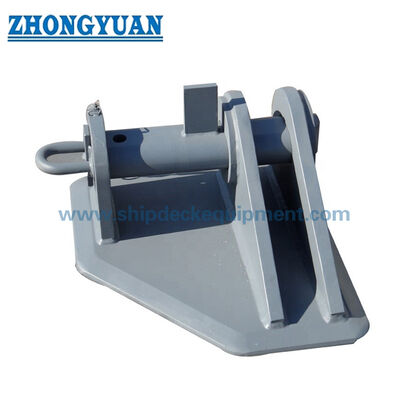
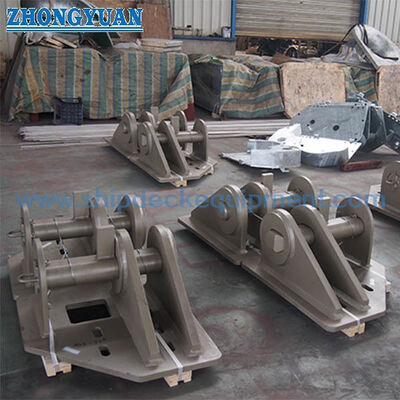
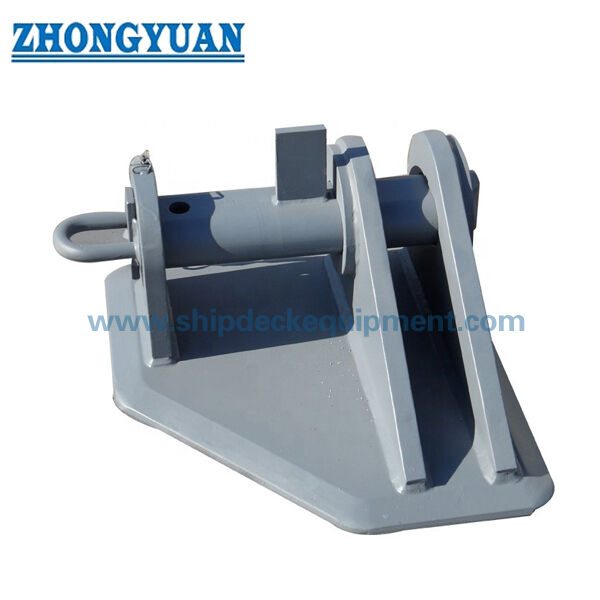
The SMIT towing bracket is a deck-welded strongpoint fitting used to secure the inboard end link of a chafing chain in a ship emergency towing arrangement. Its main structure consists of two parallel vertical plates, a welded base and supporting gussets, with a removable sliding pin passing through the side plates and the chain end link. It is normally installed on the forecastle deck and arranged together with the towing fairlead, chafing chain, towing pennant and reinforced supporting deck structure.
This product range covers nominal chain diameters from 54 to 95 mm, with supplied safe working loads from 1,000 to 3,000 kN and supplied minimum breaking loads from 2,000 to 6,570 kN. Selection must not be made by chain diameter alone: chain grade, end-link geometry, pin diameter, towing direction, deck foundation and class approval basis must be confirmed. The standard manual sliding pin is intended for connection and disconnection after the chain has been safely de-tensioned; it should not be presented as a powered quick-release device for releasing a loaded chain.
Quick Specifications
- Product type: Deck-welded SMIT towing bracket → secures the end link of a chafing chain at the inboard emergency towing strongpoint.
- Structural form: Two parallel vertical plates + sliding pin + reinforced base → provides a direct mechanical connection between chain end link and ship structure.
- Nominal chain diameter: 54 / 76 / 84 / 95 mm → final selection must also match chain grade, link dimensions and approved towing arrangement.
- Supplied load range: SWL 1,000–3,000 kN; MBL 2,000–6,570 kN → SWL and MBL remain separate values and should be verified against the project load basis.
- Installation: Welded to forecastle deck or approved strongpoint foundation → deck girders, stiffeners, weld details and load direction require ship-design confirmation.
- Material options: C-Mn steel, mild steel and high-tensile steel for fabricated parts; forged alloy steel option for the sliding pin → exact grades and heat treatment to be confirmed.
- Surface treatment: Sa 2.5 blasting + one layer of epoxy shop primer as reference → final marine coating system follows vessel specification.
- Engineering and inspection: Structural calculation / FEA, welding procedure review, material traceability and NDT can be arranged according to project and class requirements.
Main Technical Parameters
Main webpage selection data from the supplied parameter table. Dimensions are in mm unless otherwise stated.
| Chain Nominal Dia. (mm} |
A | B | C | D | E | F | H | s | Weight(kg) | SWL(KN) | MBL(KN) |
| 54 | 720 | 650 | 115 | 75 | 100 | 205 | 30 | 118 | 195 | 1000 | 2000 |
| 76 | 900 | 800 | 160 | 110 | 150 | 240 | 30 | 170 | 390 | 2000 | 4000 |
| 84 | 1018 | 905 | 170 | 120 | 160 | 273 | 35 | 210 | 560 | 2500 | 5000 |
| 95 | 1120 | 940 | 195 | 135 | 170 | 290 | 40 | 276 | 760 | 3000 | 6570 |
Selection & Inquiry Guide
Step 1: Confirm the product as a SMIT towing bracket for the ship emergency towing arrangement, together with the installation location and required chain lead.
Step 2: Confirm nominal chain diameter, chain grade, common-link and end-link dimensions, supplied SWL / MBL requirement, and the approved design-load basis.
Step 3: Provide the towing arrangement drawing showing the bracket, fairlead, chafing chain, towing pennant, expected horizontal / vertical lead angles and pin-access direction.
Step 4: Confirm base foundation, deck plate thickness, supporting girders / stiffeners, welding details and whether structural calculation or FEA is required for class review.
Step 5: Confirm body-plate and sliding-pin material grades, heat treatment, material certificates, WPS / PQR, NDT scope, coating system and class inspection requirement.
Step 6: Provide quantity, vessel type, newbuilding or retrofit status, delivery destination, required delivery time, approved drawing or reference photo if available.
Structure
Welded base plate | Two parallel vertical side plates | Sliding securing pin | Pin-retaining arrangement | Chain end-link seating space | Reinforcing gussets | Deck welding interface | Marine coating system
Towing, Welding & Engineering Advantages
- The sliding-pin arrangement provides a simple and inspectable mechanical connection for the chafing chain end link, while allowing the chain to be removed when the system is unloaded.
- Parallel side plates control the chain-link position around the pin; internal clearance, pin diameter and plate spacing should be matched to the actual end-link geometry rather than nominal chain diameter only.
- The reinforced welded base transfers towing force into the forecastle deck foundation. Efficient load distribution depends on alignment with deck girders, stiffeners and the approved towing-force direction.
- Machining and dimensional control of the pin holes, sliding pin and retaining features help maintain assembly fit, pin insertion clearance and replacement interchangeability.
- Structural calculation or finite element analysis can be prepared according to project requirement to review side-plate stress, pin bearing, base transition, gussets, welds and supporting-deck load transfer.
- Welding preparation, WPS / PQR, welder qualification and NDT can be defined in the approved inspection and test plan. The final scope remains subject to class and project requirements.
- Material traceability and controlled surface preparation support class inspection and long-term corrosion protection; the final coating system should be coordinated with the vessel painting specification.
- The manual sliding pin should be operated only under an approved procedure and with the towing load safely removed. A dedicated remote or load-release system is required when release under tension is an operational requirement.
Custom Attributes
- Core Function: Chafing-chain end-link securing → forms the inboard connection point of an emergency towing arrangement.
- Connection Type: Manual sliding pin → passes through both vertical plates and the selected chain end link.
- Nominal Chain Diameter: 54 / 76 / 84 / 95 mm → chain grade and exact link geometry remain mandatory confirmation items.
- Supplied Load Range: SWL 1,000–3,000 kN; MBL 2,000–6,570 kN → values are not interchangeable and should follow the approved load basis.
- Mounting: Deck welded → foundation scantlings, weld size and supporting structure are project-specific.
- Body Material: C-Mn / mild / high-tensile steel options → final plate grade and through-thickness requirement, if any, to be confirmed.
- Sliding Pin: Forged alloy steel option → material grade, heat treatment, hardness and NDT to be confirmed by approved drawing.
- Engineering Review: Calculation / FEA available according to project requirement → used to assess bracket, weld and supporting-deck load paths.
- Certificate Requirement: Available according to order scope → material, maker, load-test and class certificate requirements must be confirmed before quotation.
How It Works
Chafing-chain end link is positioned between the vertical plates → Sliding pin is inserted through the first plate, chain link and second plate → Pin-retaining device is secured → Towing force transfers through the pin, side plates and welded base into the reinforced deck structure → Pin is removed only after the chain is safely de-tensioned and the approved operating procedure permits disconnection
Applications
Tanker bow emergency towing arrangements | Chafing-chain strongpoints | Ship emergency towing systems | FPSO and offshore-unit towing connections where specified | Newbuilding and retrofit projects
Certifications & Advantages
Certificates and class inspection can be arranged according to project requirement, approved drawings, material traceability, welding / NDT scope, testing scope and classification society approval procedure.
Certification: CCS, NK, BV, ABS, DNV, LR, KR, IRS, RS, RINA, CRS, Makers Test Certificate.
Drawing & Photos

FAQ
Q1: What is the difference between SWL and MBL in the supplied table?
A1: SWL is the stated allowable working load for the bracket, while MBL is the stated minimum breaking load. They must not be used interchangeably. For a towing fitting, the final marking term may be TOW rather than SWL depending on the class rule and approved towing arrangement plan.
Q2: Can the sliding pin be removed while the chafing chain is under towing load?
A2: The standard manual pin should not be treated as a safe under-load quick-release device. The chain should be safely de-tensioned before pin removal. Where emergency release under tension is required, a purpose-designed remote or controlled-release system should be specified and separately approved.
Q3: What information is required before quotation and engineering review?
A3: Provide chain diameter, grade and end-link dimensions; required SWL / MBL or class load basis; towing arrangement and load directions; fairlead position; bracket foundation and deck structure; material, coating, NDT and certificate requirements; quantity, destination and delivery time.