


|
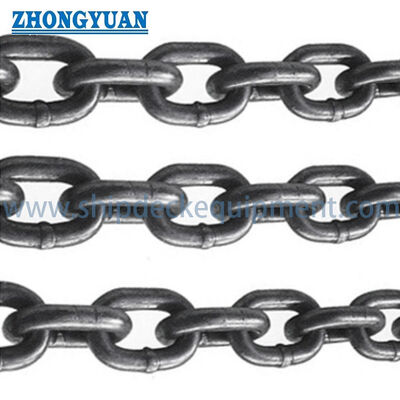
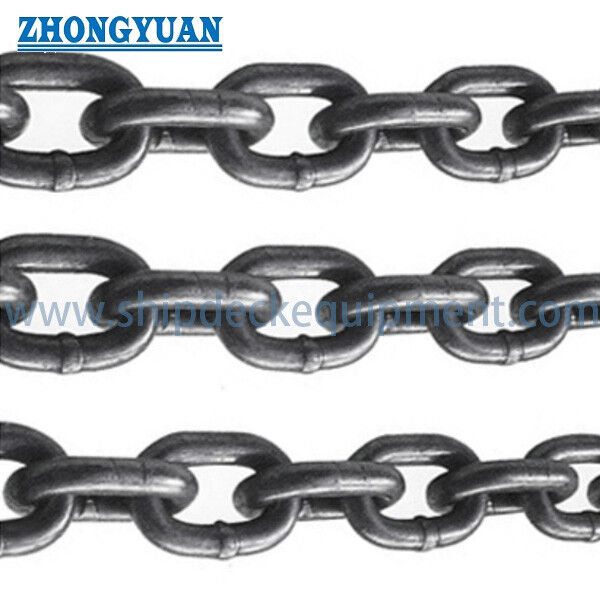
DIN 764 Round Steel Link Conveyor Chain | Calibrated Welded Chain for Chain Wheels and Rollers
Product Details:
| Place of Origin: | China |
| Brand Name: | Zhongyuan Marine Equipmen |
| Certification: | CCS, NK, BV, ABS, DNV, LR, KR, IRS, RS, RINA, CRS, Makers Test Certificate |
| Model Number: | Standard or Customized |
Payment & Shipping Terms:
| Minimum Order Quantity: | 1 Unit |
|---|---|
| Price: | Based on quotation |
| Packaging Details: | Export standard pallet or customized packing |
| Delivery Time: | Based on project requirements |
| Payment Terms: | T/T, L/C |
| Supply Ability: | Customized production based on project requirements |
|
Detail Information |
|||
| Type: | Cranked Link Chain | Material: | Alloy Steel, High Tensile, Heat Treated. |
|---|---|---|---|
| Surface Treatment: | Zinc Plated, Black Painted, Hot Dip Galvanized, Powder Coated | Structure: | Flash Butt Welded Chain |
| Feature: | Heat Resistant | Chain Size: | 4mm To 26mm |
| Color: | Self Color, Red ,Green, Or As To Your Request | Application: | Ship,Iron And Steel Industry, Petroleum Chemical Industry, Coal Mine |
| Highlight: | German Standard DIN 764 Chain,DIN 764 Round Steel Link Chain,DIN 764 Link Chain For Conveyors |
||
Product Description
DIN 764 Round Steel Link Conveyor Chain | Calibrated Welded Chain for Chain Wheels and Rollers
Product Overview
DIN 764 round steel link chain is a welded, calibrated chain used primarily as a traction element in continuous chain conveyors. Its controlled pitch, link width, and multi-link gauge length are important where the chain must engage a chain wheel, pocket wheel, guide, or roller system without climbing, binding, or uneven load transfer.
The current DIN 764 series is divided into DIN 764-1 for grade 3 and DIN 764-2 for grade 5, both with a nominal pitch of t = 3.5 x d. The supplied 4-26 mm table represents a legacy or commercial DIN 764 dimensional series and should not be presented as the complete current DIN 764-1 / DIN 764-2 size and mechanical-property table without checking the purchased standard edition.
Current DIN 764 Standard Position
DIN 764-1:2010-10 and DIN 764-2:2010-10 are current German standards for tested, fine-tolerance round steel link chains used in chain conveyors. Part 1 covers grade 3 and Part 2 covers grade 5. The former DIN 764-1:1992 grade 2 document is withdrawn; grade 2 conveyor or bucket-elevator applications should be checked against the applicable current standard, including DIN 5696-1 where relevant.
DIN 764 chains are not lifting chains, hoist chains, chain slings, or load-securing chains. Breaking load and test-load values must not be converted into a lifting SWL or working load limit.
Quick Specifications
- Product type: Calibrated welded round steel link chain → used as a traction element in continuous conveyor systems.
- Current DIN grades: Grade 3 under DIN 764-1 and grade 5 under DIN 764-2 → exact grade must be selected from the conveyor design and purchased standard.
- Legacy supplied size range: 4 to 26 mm bar diameter → useful for replacement and commercial-size reference, but not automatically the complete current DIN range.
- Nominal geometry: Medium-pitch round-link form, generally t = 3.5 x d in the current standard → chain size must be matched by diameter, pitch, width, and gauge length.
- Tolerance selection: Chain-wheel and roller applications require different gauge-length control according to the specified tolerance class → confirm class and measurement basis before production.
- Manufacturing method: Formed and flash-butt welded links with calibration and testing → weld profile and dimensional repeatability affect drive engagement.
- Supplied breaking-load range: 7 to 320 kN → a destructive limit from the supplied table, not permissible operating force or lifting capacity.
- Surface finish: Self-coloured, black coated, zinc plated, hot-dip galvanized, or project coating → finish suitability depends on grade, heat treatment, wear, fit, and service environment.
Main Technical Parameters
| Size(d) | Inside Length(t) | Inside Width (b1) | Outside Width (b2) | Length Per 11 Links | Weight Per 100M | Breaking Load | Test Load | |||
| mm | ±mm | mm | ±mm | mm | mm | mm | ±mm | kg | kn | kg |
| 4 | 0.20 | 16 | 0.30 | 5 | 14 | 176 | 1.60 | 31.3 | 7 | 400 |
| 0.20 | 0.90 | |||||||||
| 5 | 0.20 | 18 | 0.40 | 7 | 18.2 | 198 | 1.80 | 51.4 | 11.8 | 680 |
| 0.20 | 1.00 | |||||||||
| 6 | 0.20 | 21 | 0.50 | 8 | 21.5 | 231 | 2.00 | 74.0 | 16.5 | 850 |
| 0.20 | 1.10 | |||||||||
| 8 | 0.20 | 28 | 0.50 | 11 | 29 | 308 | 2.20 | 131.5 | 32 | 1680 |
| 0.30 | 1.20 | |||||||||
| 10 | 0.30 | 35 | 0.60 | 14 | 36 | 385 | 2.70 | 200 | 50 | 2630 |
| 0.30 | 1.50 | |||||||||
| 12 | 0.30 | 42 | 0.60 | 16 | 41 | 462 | 3.20 | 298 | 70 | 3680 |
| 0.30 | 1.80 | |||||||||
| 13 | 0.40 | 45 | 0.70 | 18 | 47 | 495 | 3.50 | 350 | 80 | 4200 |
| 0.40 | 2.00 | |||||||||
| 14 | 0.45 | 49 | 0.75 | 20 | 48 | 539 | 3.80 | 406 | 92 | 4830 |
| 0.45 | 2.00 | |||||||||
| 16 | 0.50 | 56 | 0.90 | 22 | 58 | 616 | 4.30 | 520 | 125 | 6700 |
| 0.50 | 2.80 | |||||||||
| 18 | 0.80 | 63 | 1.00 | 24 | 65 | 693 | 4.70 | 650 | 160 | 8400 |
| 0.50 | 2.80 | |||||||||
| 20 | 1.00 | 70 | 1.10 | 27 | 72 | 770 | 5.40 | 820 | 200 | 10000 |
| 0.60 | 3.20 | |||||||||
| 23 | 1.20 | 80 | 1.30 | 31 | 83 | 880 | 6.20 | 1100 | 250 | 13000 |
| 0.70 | 3.50 | |||||||||
| 26 | 1.30 | 91 | 1.50 | 35 | 94 | 1001 | 7.00 | 1400 | 320 | 16000 |
| 0.80 | 4.00 | |||||||||
Chain Geometry and Drive Matching
- Bar diameter d defines the nominal chain size, while pitch t controls the engagement spacing between consecutive links.
- Inside width b1 must provide the required clearance for attachments, guides, scraper connections, or mating components.
- Outside width b2 must clear the chain-wheel pocket, guide rail, roller, casing, and surrounding conveyor structure.
- The measured length over 11 links controls accumulated pitch error. Excessive gauge-length deviation can cause chain-wheel climbing, impact loading, uneven wear, and poor load sharing.
- For parallel chain strands, matched length, equal link count, common calibration basis, and identified pairing should be specified to reduce skew and unequal load distribution.
- Existing chain wheels should be inspected for pocket wear, pitch enlargement, misalignment, and tooth or pocket damage before a replacement chain is ordered.
Manufacturing, Calibration and Testing
- Round steel bar is cut, heated or formed as required, bent into link shape, and closed by an approved flash-butt or equivalent welding process.
- Weld upset and link profile should be controlled so that the joint does not interfere with adjacent links, chain wheels, guides, or attachments.
- Calibration controls pitch and multi-link gauge length after welding and any required heat treatment.
- Mechanical properties depend on the selected DIN grade, steel chemistry, heat treatment, link size, and applicable standard edition; “high tensile” is not a complete material specification.
- Testing and inspection may include dimensional verification, manufacturing proof testing, representative breaking testing, bend or elongation checks, weld inspection, material traceability, and marking according to the agreed standard and order scope.
- DIN 685-3 provides a current German reference for testing tested round steel link chains, while DIN 685-4 covers marking and test certificates; applicability should be confirmed in the purchase specification.
Surface Finish and Service Conditions
• Self-coloured or black-coated chain is commonly selected where dimensional fit and wear contact are more important than a thick protective coating.
• Electro-zinc plating can improve storage and atmospheric corrosion resistance, but coating durability in abrasive conveyor contact is limited.
• Hot-dip galvanizing adds a thicker coating and must be assessed for dimensional allowance, link articulation, chain-wheel fit, steel-grade suitability, and post-treatment inspection.
• Powder coating or coloured paint can support identification and corrosion protection, but coating on bearing and contact surfaces may wear rapidly.
• For high-temperature, chemically aggressive, mining, marine, or petroleum-service environments, temperature, corrosion, abrasion, contamination, and ignition-risk requirements must be specified separately. DIN 764 compliance alone does not establish heat or chemical resistance.
Selection & Inquiry Guide
Step 1: Confirm the required standard edition and grade: DIN 764-1 grade 3, DIN 764-2 grade 5, or a legacy replacement based on an existing chain sample or drawing.
Step 2: Provide chain size d, pitch t, inside width b1, outside width b2, 11-link gauge length, tolerance class, total length, and number of links.
Step 3: Provide conveyor type, chain-wheel or roller arrangement, wheel pocket dimensions, number of parallel strands, operating speed, direction, and attachment details.
Step 4: Confirm maximum operating chain force, start-up and jam loads, duty cycle, temperature, abrasion, corrosion, material being conveyed, and required design factor.
Step 5: Confirm steel grade, heat treatment, hardness or case-hardening requirement, welding process, proof test, breaking-test sample, dimensional inspection, marking, and certificate scope.
Step 6: Confirm surface treatment, matched-pair requirement, cut length or reel / drum packing, quantity, destination, required delivery time, and provide the original chain or chain-wheel drawing if available.
Structure
Round steel open links | Medium-pitch geometry | Flash-butt welded joint | Calibrated pitch | Controlled inside and outside width | Measured 11-link gauge length | Straight or matched chain strands | Optional project-specific attachments
How It Works
Drive unit rotates the chain wheel or moves the conveyor mechanism → Calibrated links engage the wheel pockets or travel over rollers → Tensile force is transferred through alternating round links → Guides and attachments control the conveyed load → Matched geometry maintains repeatable engagement and limits pitch-related impact
Applications
Chain conveyors | Scraper conveyors | Trough conveyors | Selected bucket-elevator arrangements subject to the correct standard | Steel and bulk-material plants | Mining and mineral-handling equipment | Process-industry conveyors | Marine and shipboard conveyor systems subject to project approval
Certifications & Documentation
Material certificates, dimensional inspection reports, manufacturing proof-test records, representative breaking-test reports, heat-treatment records, weld inspection, coating records, and marking documentation can be arranged according to the selected DIN part and agreed order scope.
Certification: CCS, NK, BV, ABS, DNV, LR, KR, IRS, RS, RINA, CRS, Makers Test Certificate.
Drawing & Photos

FAQ
Q1: Is DIN 764 chain suitable for lifting, hoisting, or chain slings?
A1: No. DIN 764 conveyor chain is intended as a traction element in chain conveyors. It must not be used as a lifting chain, hoist chain, chain sling, lifting accessory, or load-securing chain.
Q2: What is the difference between current DIN 764 grade 3 and grade 5 chain?
A2: DIN 764-1 covers grade 3 and DIN 764-2 covers grade 5. Select the applicable part from the conveyor design and purchased standard; do not market grade 2 as current DIN 764 without a confirmed legacy or replacement basis.
Q3: Can a 4-26 mm commercial DIN 764 table be used as the current standard table?
A3: No. Use it only as a legacy or commercial reference and confirm dimensions, grades, proof forces, breaking forces, and tolerances against DIN 764-1 / DIN 764-2 and the approved conveyor drawing.