


 |
Liferaft Davit – Manual, Hydraulic and Electric Configurations
Product Details:
| Place of Origin: | China |
| Brand Name: | Zhongyuan Marine Equipmen |
| Certification: | CCS, NK, BV, ABS, DNV, LR, KR, IRS, RS, RINA, CRS, Makers Test Certificate |
| Model Number: | Standard or Customized |
Payment & Shipping Terms:
| Minimum Order Quantity: | 1 Unit |
|---|---|
| Price: | Based on quotation |
| Packaging Details: | Export standard pallet or customized packing |
| Delivery Time: | Based on project requirements |
| Payment Terms: | T/T, L/C |
| Supply Ability: | Customized production based on project requirements |
|
Detail Information |
|||
| Model: | Davit----JYRH21 | Max. Working Load: | 23 KN |
|---|---|---|---|
| Max. Hoisting Load: | 14kN | Lowering Speed Of Raft: | 40~60m/min |
| Empty Hook Recovery Speed: | ≥18 M/min | Max. Slewing Load: | 3.0 KN |
| Max. Slewing Angle: | 3300 | Designed Conditions: | Heel100+Trim200 |
| Boat Fall: | 16mm Dia. Non-twist, Galv. | ||
| Highlight: | liferaft davit,380V liferaft davit,life boat davit |
||
Product Description
Liferaft Davit – Manual, Hydraulic and Electric Configurations
Product Overview
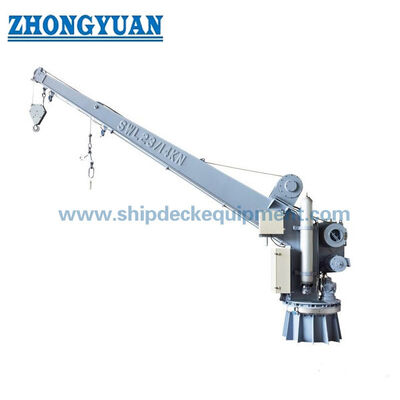
A liferaft davit is a dedicated single-arm launching appliance for lowering a davit-launched inflatable liferaft to the water. The davit may be arranged for manual, hydraulic or electric slewing, with winch operation and recovery functions selected separately for the installation.
The liferaft davit can be specified with manual, hydraulic or electric slewing, together with a winch arrangement selected for the required launch and recovery duty. In the manual-slewing configuration, the raft is lowered by gravity under controlled winch braking. Power-assisted configurations are selected according to the vessel's deck layout, handling requirements and available utilities.
Quick Specifications
• Product category: Dedicated davit-launched liferaft launching appliance; separate from rescue-boat/liferaft combined davits.
• Configuration options: Manual, hydraulic or electric slewing, with matching winch arrangements.
• Operation: Slewing, lowering and recovery functions selected to suit the liferaft installation.
• Lowering: Gravity lowering with controlled winch braking in the manual-slewing configuration.
• System interface: Approved liferaft suspension, automatic release hook, winch/fall, deck foundation and embarkation arrangement.
• Selection basis: Fully loaded suspended liferaft mass, launch height, outreach, recovery load and deck arrangement.
Main Technical Parameters
Range / Configuration Summary
|
Configuration |
Slewing / Turning-Out |
Winch / Recovery |
|---|---|---|
| Manual slewing | Hand-operated gearbox and handle | Manual recovery; gravity lowering with controlled winch braking |
| Manual slewing + electric winch | Hand-operated gearbox and handle | Electric winch for powered recovery |
| Hydraulic slewing | Hydraulic slewing drive | Winch type and recovery capacity selected for the application |
| Electric slewing | Electric slewing drive | Winch type and recovery capacity selected for the application |
Manual-Slewing Technical Parameters
|
Parameter |
Manual-Slewing Configuration |
|---|---|
| Maximum working / launching load | 23 kN |
| Minimum launching load | 5 kN |
| Maximum hoisting load | 3 kN |
| Maximum manual recovery load | 3 kN |
| Maximum slewing load | 3 kN |
| Maximum slewing angle | 330° |
| Wire rope | Ø16 mm; rope MBL 138 kN |
| Lowering speed | 40–60 m/min |
| Hoisting speed, no load / loaded | 10 m/min / 0.5 m/min |
| Approximate self-weight | 1,300 kg |
Structure & Components
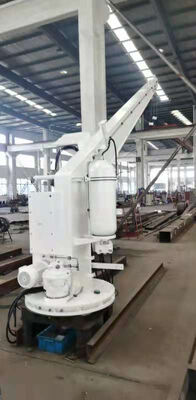
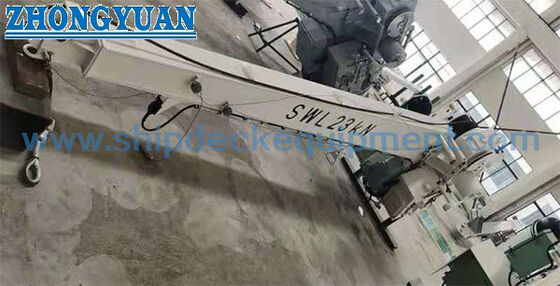
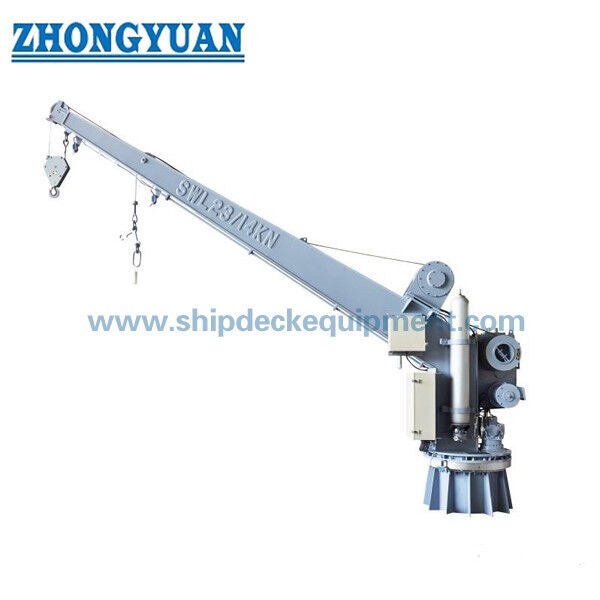
The manual-slewing liferaft davit comprises a single steel arm, slewing base, manual gearbox and handle, single fall, winch, remote brake-control wire and liferaft release-hook interface. Steel components and surface protection are selected for marine installation and the specified operating conditions.
Hydraulic slewing uses a powered hydraulic drive for turning out the davit arm, while electric slewing uses a motor-driven arrangement. Controls, power supply and emergency operating provisions are selected for the vessel installation.
Drive & Control
Slewing / turning-out: The manual arrangement uses a hand-operated gearbox and handle. Hydraulic and electric slewing options allow powered movement of the davit arm, with controls arranged for the selected installation.
Lowering: The manual-slewing arrangement lowers the liferaft by gravity under controlled winch braking. The brake may be operated remotely from the liferaft or locally from the deck. Recovery is performed through the selected winch arrangement; recovery load is specified independently of the davit's launching load.
Control arrangements may include local operation, remote lowering control and emergency/manual provisions according to the selected configuration.
Load & Selection Basis
Working/launching load, minimum launching load, recovery load, slewing load and wire-rope minimum breaking load describe different functions. The selected davit and winch must meet the suspended liferaft load and recovery requirements independently; liferaft capacity alone is not a substitute for its fully loaded suspended mass.
The liferaft, suspension point, automatic release hook, winch/fall, deck foundation and embarking position should be matched as one launching arrangement. A combined rescue-boat/liferaft davit is a separate equipment category where the same appliance serves both craft types.
Materials & Surface Protection
The manual arrangement uses steel davit and winch components with marine surface protection. Coating, fasteners and protective finishes can be specified to suit the installation environment and project requirements..
Standards & Certification
Liferaft launching appliances, associated braking systems and release hooks should be selected according to the applicable SOLAS/LSA Code requirements and the approval conditions of the chosen configuration. Please specify flag, class and required documentation in the inquiry.
Approval and documentation requirements are determined by the selected davit configuration, applicable flag/class rules and the project's specified certificate scope.
Selection & Inquiry Guide
1. Confirm the davit-launched liferaft type, fully loaded suspended mass, embarkation station and approved automatic release hook.
2. Choose the required slewing drive: manual, hydraulic or electric; state separately whether powered winch recovery is needed.
3. Provide required launch height, outreach, deck/foundation geometry, power or hydraulic utilities and any emergency-operation requirement.
4. Confirm the permitted launching and recovery load cases, winch/fall arrangement and operating controls.
5. Specify required current type approval, MED/flag/class documents and project test scope.
Applications
Dedicated davit-launched inflatable liferaft systems | Passenger and cargo vessel liferaft stations | Deck arrangements needing controlled slewing | Replacement or retrofit of existing liferaft-only davits | Project-specific powered-operation requirements
Drawing & Photos

FAQ
Q1. Does an electric liferaft davit always have electric slewing? No. An electric winch may be combined with manual slewing; slewing and winch operation should be specified separately.
Q2. Are launching and recovery load ratings the same for every configuration? No. The allowable launching, slewing and recovery loads depend on the selected davit and winch arrangement.
Q3. Does the same automatic release hook suit every davit? The hook and suspension arrangement must be compatible with the selected liferaft and launching appliance.