


|
70–1000 kN Marine Hydraulic Towing Winch for Ship Towing | Single or Double Drum
Product Details:
| Place of Origin: | China |
| Brand Name: | Zhongyuan Marine Equipmen |
| Certification: | CCS, NK, BV, ABS, DNV, LR, KR, IRS, RS, RINA, CRS, Makers Test Certificate |
| Model Number: | Standard or Customized |
Payment & Shipping Terms:
| Minimum Order Quantity: | 1 Unit |
|---|---|
| Price: | Based on quotation |
| Packaging Details: | Export standard pallet or customized packing |
| Delivery Time: | Based on project requirements |
| Payment Terms: | T/T, L/C |
| Supply Ability: | Customized production based on project requirements |
|
Detail Information |
|||
| Safety Pull Capacity: | 70-1000KN | Speed: | 5-10m/min |
|---|---|---|---|
| Drum Capacity: | 40 To 1000m | Motor Power: | 30 To 180 Kw |
| Rope Dia: | 28 – 64 (mm) | Control Position: | Remote And Local Control |
| Optional: | Load Measuring, Rope Speed And Length Measuring Device | Power Supply: | AC380V, 50HZ 3PH, AC415V 50HZ 3PH, AC440 60HZ 3PH |
| Auto Spooling Device: | Optional | Material: | Mild Steel |
| Surface Treatment: | Sandblasting To S2.5 + 3 Layers Of Epoxy Paint | Classification Certificates: | CCS, NK, BV, ABS, DNV, LR, KR, RINA, IRS, RS, Etc |
| Highlight: | 1000KN hydraulic towing winch,1000KN hydraulic towing winches,10m/min marine towing winches |
||
Product Description
70–1000 kN Marine Hydraulic Towing Winch for Ship Towing | Single or Double Drum
Product Overview
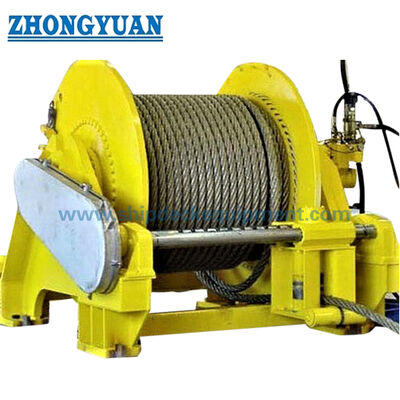
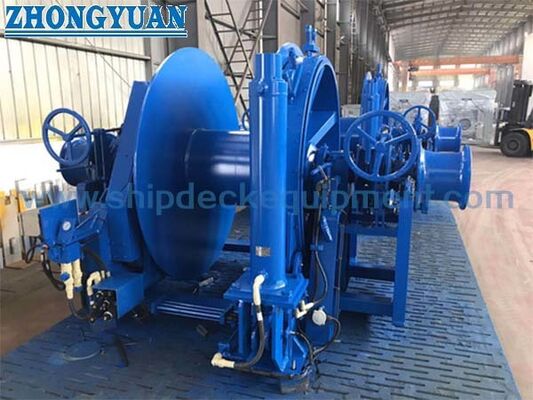
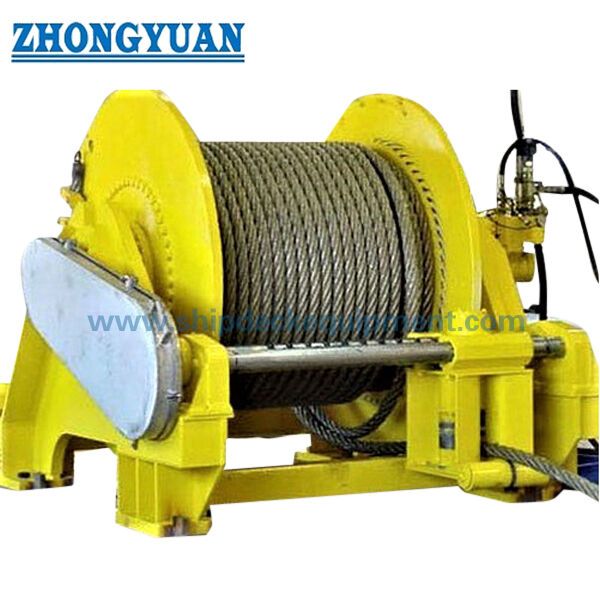
The 70-1000 kN marine hydraulic towing winch is project-engineered deck machinery for paying out, recovering, holding, and storing towing wire during tug, workboat, salvage, and ship-assistance operations. The hydraulic drive can be arranged with a single or double drum, one or two optional warping heads, customized drum capacity, and an optional level-wind device. Local and remote control can be combined with optional line-pull, rope-speed, and paid-out-length indication.
Selection must be based on the approved towing duty rather than rated pull alone. The buyer should confirm towline diameter, construction and MBL, required pull at the specified drum layer, line speed, drum capacity, brake and rendering requirements, duty cycle, hydraulic power-unit data, line-lead arrangement, deck foundation, and classification scope. The four configurations below are reference examples and do not define the complete 70-1000 kN product range. This towing winch is not presented as a lifting winch.
Quick Specifications
- Rated pull range: 70 to 1000 kN → select by towing duty, bollard pull, towline data, drum layer, and approved load basis.
- Rated line speed: 5 to 10 m/min; listed examples use 0-10 m/min variable speed → confirm speed at rated pull and recovery speed at reduced load.
- Wire-rope range: 28 to 64 mm diameter with approximately 40 to 1000 m storage → drum core, flange, grooving, and number of layers are customized.
- Drum arrangement: single or double drum → choose according to one-line or two-line towing arrangement, operational redundancy, and deck space.
- Warping heads: one or two units optional → provide auxiliary line-handling capability; size and duty must be confirmed separately.
- Drive and power: hydraulic drive with 30 to 180 kW stated motor-power range → final HPU pressure, flow, motor power, cooling, and efficiency require project calculation.
- Control: local and remote stations available → control location, operator visibility, emergency stop, alarms, and communication interface should be defined in the approved control philosophy.
- Optional monitoring and winding: line pull, rope speed, paid-out length, and automatic spooling → useful for towing control and multi-layer rope management when specified.
Main Technical Parameters
|
Selection & Inquiry Guide
Step 1: Define the vessel and duty: harbor towing, escort or ocean towing, salvage, ship assistance, expected bollard pull, towing mode, duty cycle, ambient conditions, and required classification society.
Step 2: Provide towline data: wire-rope or approved alternative, diameter, construction, MBL, unit mass, required storage length, end termination, minimum bending guidance, and preferred number of drum layers.
Step 3: Confirm performance values separately: rated pull and drum layer, rated speed, recovery speed at reduced load, brake holding load, rendering load and speed, free-spooling requirement, and emergency-release function if required by the vessel or class.
Step 4: Select the arrangement: single or double drum, one or two warping heads, level-wind or spooling device, drum grooving, clutch arrangement, brake type, guard arrangement, and maintenance access.
Step 5: Confirm the hydraulic and electrical interfaces: HPU pressure and flow, electric-motor power, 380 V/50 Hz, 415 V/50 Hz or 440 V/60 Hz three-phase supply, cooling medium, control voltage, IP rating, alarms, and local/remote station layout.
Step 6: Provide GA drawing, deck foundation and reinforcement information, line-lead geometry, quantity, material and coating requirement, certificate and witness scope, delivery destination, and required delivery time.
Structure
Welded steel bedframe | Single or double rope drum | Hydraulic motor and reduction drive | Project-specified brake and clutch arrangement | Optional one or two warping heads | Optional level-wind device | Local and remote control stations | Optional line-pull, speed, and length monitoring | Deck foundation interface
Towing, Hydraulic and Engineering Advantages
- The drum can be sized around the specified rope diameter, storage length, core diameter, flange margin, groove form, and number of layers. This avoids treating rope capacity as a simple length value without checking winding geometry.
- Pull available at the rope changes with the effective drum radius. The approved data sheet should therefore state the drum layer used for rated pull and the corresponding line speed.
- Hydraulic drive supports controlled low-speed operation and flexible local/remote control. The final hydraulic motor, gearbox, HPU flow, pressure, heat rejection, and starting characteristics must be matched as one system.
- Single- and double-drum arrangements allow the winch layout to be adapted to vessel towing practice. Double-drum supply does not automatically mean simultaneous full-load operation; the operating philosophy and power sharing require confirmation.
- An optional level-wind device can improve multi-layer spooling where long wire capacity and restricted fleet angle make manual rope distribution unsuitable. The level-wind travel, pitch, synchronization, and bypass method should match the selected rope and drum.
- Optional load, rope-speed, and paid-out-length measurement provides useful operating information, but sensor range, accuracy, calibration method, display location, data logging, and alarm set points should be defined before quotation.
- The winch bedframe, holding components, deck seating, welds, and under-deck reinforcement form one load path. Foundation reactions and allowable line-lead angles should be supplied for shipyard structural approval.
- Emergency release, rendering, overload protection, fail-safe braking, emergency stopping, and manual recovery are safety-related functions that may be required by the vessel duty or class. They are not assumed as standard unless confirmed in the project specification.
Custom Attributes
- Rated Pull: 70-1000 kN → use as a project selection range; the rated drum layer and duty basis must be stated.
- Rated Speed: 5-10 m/min, with 0-10 m/min shown for reference models → confirm speed at rated pull and reduced-load recovery speed.
- Rope Capacity: 28-64 mm wire rope and approximately 40-1000 m → customized drum dimensions and winding arrangement are required.
- Drum Configuration: Single or double drum → selected according to towing-line arrangement, redundancy, power sharing, and available deck space.
- Warping Head: Single or double optional → intended for auxiliary line handling; rated duty and geometry require separate confirmation.
- Control: Local and remote control → station arrangement, emergency stops, indicators, alarms, and interlocks follow the approved control philosophy.
- Monitoring: Line pull / rope speed / paid-out length optional → sensor type, range, accuracy, calibration, and display interface are project-specific.
- Power Supply: AC 380 V 50 Hz 3PH / AC 415 V 50 Hz 3PH / AC 440 V 60 Hz 3PH → normally associated with the hydraulic power unit and control system; final interface to be confirmed.
- Material: Mild-steel fabricated structure → exact plate, shaft, drum, fastener, and low-temperature material grades are subject to approved drawings and class requirements.
- Surface Treatment: Sa 2.5 blasting + three-coat epoxy system → primer, intermediate coat, topcoat, total dry-film thickness, color, and touch-up procedure must be confirmed.
How It Works
Hydraulic power unit supplies pressurized oil → Hydraulic motor and reduction drive rotate the drum → Towline is paid out or recovered at controlled speed → Brake and clutch arrangement holds, stops, or releases the drum as specified → Optional level-wind distributes the rope → Optional sensors display line pull, speed, and paid-out length
Applications
Harbor tug towing | Ship-assistance operations | Salvage and emergency towing | Workboats and utility vessels | Multipurpose support vessels | Ocean-towing arrangements subject to approved design | Newbuilding and retrofit projects
Certifications & Advantages
Certificates and classification involvement can be arranged according to project requirement, approved drawings, material traceability, inspection scope, testing plan, and class approval procedure. The required society and certificate type should be confirmed before quotation.
Certification: CCS, NK, BV, ABS, DNV, LR, KR, IRS, RS, RINA, CRS, Makers Test Certificate.
Drawing & Photos

FAQ
Q1: Is rated pull the same as brake holding load or towline MBL?
A1: No. Rated pull is the powered hauling force at a stated drum layer and speed. Brake holding load is a separate static holding value, while towline MBL is the rope breaking-strength value. These terms must not be interchanged.
Q2: What information is required to size the drum and hydraulic drive?
A2: Provide rope diameter, construction, MBL, storage length, preferred layers, drum grooving, rated pull layer, line speed, duty cycle, brake and rendering requirements, hydraulic supply, and available installation space. These values determine drum geometry, torque, motor, gearbox, HPU, and cooling.
Q3: What should be confirmed for class approval and shipyard installation?
A3: Confirm vessel towing duty, applicable class rules, load cases and line-lead angles, foundation reactions, deck reinforcement, brake and release philosophy, control and alarm functions, material traceability, welding/NDT, FAT or load test scope, marking, and final documentation.