


|
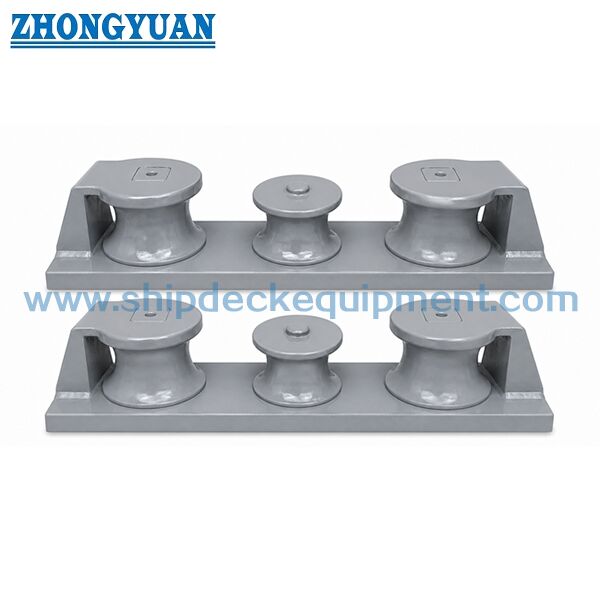
75–350 mm Marine Three-Roller Chock | CB/T 38-1999 Type C with Cast Steel Rollers
Product Details:
| Place of Origin: | China |
| Brand Name: | Zhongyuan Marine Equipmen |
| Certification: | CCS, NK, BV, ABS, DNV, LR, KR, IRS, RS, RINA, CRS, Makers Test Certificate |
| Model Number: | Standard or Customized |
Payment & Shipping Terms:
| Minimum Order Quantity: | 1 Unit |
|---|---|
| Price: | Based on quotation |
| Packaging Details: | Export standard pallet or customized packing |
| Delivery Time: | Based on project requirements |
| Payment Terms: | T/T, L/C |
| Supply Ability: | Customized production based on project requirements |
|
Detail Information |
|||
| Technical Standard: | CB/T 38-1999 | Type: | Single Roller Form C |
|---|---|---|---|
| Roller Diameters: | 75~350mm | Roller No.: | Three Rollers |
| Roller Weight: | 27-1915kg | Materials: | Mild Steel, C-Mn Steel, Stainless Steel, Casting Steel, Nodular Cast Iron |
| Surface Treatment: | Sandblasting To S2.5 + One Layer Of Epoxy Shop Primer, Galvanized, Polished, Customized Surface Treatment Available. | Classification Certificates: | CCS, NK, BV, ABS, DNV, LR, KR, IRS, RS, Etc. |
| Highlight: | Ship Mooring Equipment Fairlead,3 Rollers Fairlead,3 Rollers Fairlead Ship Mooring Equipment |
||
Product Description
75–350 mm Marine Three-Roller Chock | CB/T 38-1999 Type C with Cast Steel Rollers
Product Overview
Marine three roller chock is designed to guide mooring ropes through a fixed opening while reducing friction and controlling rope direction.
Compared with conventional chock, the integrated three-roller structure allows multi-direction rope lead and significantly reduces local stress and rope wear.
This product follows CB/T 38-1999 Type C standard, replacing CB39-66 Type C.
CB/T 38-1999 adopts a welded base structure, providing improved load transfer and higher structural integrity compared to bolt-on CB39-66 design.
Each model corresponds to a specific rope breaking load (MBL), enabling accurate load-based selection.
Quick Specifications
- Structure: Three rollers → Multi-direction rope guidance
- Applicable Rope Diameter: 7–37 mm → Standard selection range
- Applicable Rope MBL: 23–583 kN → Key selection parameter
- Mounting: Welded base (CB/T 38-1999) / Bolt-on (CB39-66 replacement)
- Material: Casting steel → High strength and durability
- Surface: Smooth machined → Protect rope
- Certification: CCS, NK, BV, ABS, DNV, LR, KR, IRS, RS, RINA, CRS, Makers Test Certificate
Main Technical Parameters (CB/T 38-1999 Type C)
| Nominal Size | Rope Max Break (kN) | Wire Rope Dia | Fiber Rope Dia | L | B | H | L1 | D | Weight (kg) |
| 75 | 23.3 | 7.4 | 12 | 550 | 170 | 116 | 150 | 75 | 27 |
| 100 | 52.5 | 11 | 18 | 750 | 200 | 147 | 210 | 100 | 60 |
| 125 | 93.4 | 15 | 24 | 920 | 250 | 173 | 260 | 125 | 116 |
| 150 | 145.8 | 18.5 | 30 | 1120 | 300 | 201 | 320 | 150 | 198 |
| 200 | 246.6 | 24 | 40 | 1420 | 370 | 251 | 410 | 200 | 398 |
| 250 | 373.6 | 30 | 48 | 1780 | 470 | 300 | 520 | 250 | 767 |
| 300 | 472.7 | 33.5 | 56 | 2120 | 550 | 353 | 620 | 300 | 1240 |
| 350 | 583.5 | 37.5 | 64 | 2440 | 640 | 386 | 720 | 350 | 1915 |
Load & Selection Basis
The 'Rope Max Break (kN)' refers to the maximum breaking load (MBL) of the applicable rope.
Each chock size is matched to a corresponding rope strength level.
Reference SWL ≈ Rope MBL ÷ Safety Factor (typically 1.5–2.0).
The chock is designed to withstand loads equal to or exceeding rope breaking strength, ensuring structural safety under extreme conditions.
Selection Guide
Step 1 – Select rope diameter → Based on mooring line size
Step 2 – Confirm rope breaking load (MBL) → Primary selection parameter
Step 3 – Select chock size → Match both rope diameter and MBL
Step 4 – Confirm installation type → Welded (newbuild) / Bolt-on (replacement)
Step 5 – Confirm certification requirement
Engineering Note
CB/T 38-1999 introduces load-based matching, where each model corresponds to a specific rope breaking strength.
This ensures better alignment between mooring system design and actual operational loads.
Structure
Three rollers | Casting body | Welded base | Reinforced structure
Custom Attributes
Three-roller design → Load distribution and reduced rope wear
Free rotating rollers → Minimize friction
Casting steel body → High strength
Smooth contact surface → Protect rope
Inquiry Guide
Provide rope diameter, rope MBL, installation type, vessel type and certification requirements.
How It Works
Rope passes through chock → rollers rotate → friction reduced → rope guided smoothly → wear minimized.
Applications
Ship bow | Ship stern | Bulwark | Deck edge mooring
Certifications & Advantages
Certification: CCS, NK, BV, ABS, DNV, LR, KR, IRS, RS, RINA, CRS, Makers Test Certificate
Drawing & Photos
General arrangement drawing and product photos

Ordering
Specify: size, material, coating, certification
FAQ
Q1: Why use three roller chock?
A: To reduce friction, distribute load and protect mooring rope.
Q2: Do rollers rotate?
A: Yes, all rollers rotate freely to minimize wear.
Q3: How to select size?
A: Based on rope diameter and breaking load from the table.
Q4: Which standard should I choose for my project?
A: For newbuild projects, updated standards such as CB/T 38-1999 or classification society requirements are recommended.
For existing vessels, CB 39-66 dimensions are typically used for direct replacement.