


|
Class Approval Offshore Fire Hose Winch Ship Deck Equipment
Product Details:
| Place of Origin: | China |
| Brand Name: | Zhongyuan Marine Equipmen |
| Certification: | CCS, NK, BV, ABS, DNV, LR, KR, IRS, RS, RINA, CRS, Makers Test Certificate |
| Model Number: | Standard or Customized |
Payment & Shipping Terms:
| Minimum Order Quantity: | 1 Unit |
|---|---|
| Price: | Based on quotation |
| Packaging Details: | Export standard pallet or customized packing |
| Delivery Time: | Based on project requirements |
| Payment Terms: | T/T, L/C |
| Supply Ability: | Customized production based on project requirements |
|
Detail Information |
|||
| Safety Pull Capacity: | 50KN | Speed: | 8-30m/min |
|---|---|---|---|
| Drum Capacity: | 40 To 250m | Suction & Delivery Hose Dia.: | 254mm (Fire Retardant Certificate) |
| Control Position: | Remote And Local Control | Power Supply: | Electric Driven Motors 7.5kW (415V/50Hz) For Offshore Use, Included Marine Break, Control Box (IP56) And Wireless Remote Control |
| Material: | Mild Steel & Stainless Steel | Surface Treatment: | Sandblasting To S2.5 + 3 Layers Of Epoxy Paint |
| Certificate: | IACS Classification Certificates, Mill Certificate | ||
| Highlight: | Steel Hose Winch,Fire Hose Winch,Hose Winch Ship Deck Equipment |
||
Product Description
Electric Fire Hose Reel | Offshore Flexible Hose Handling Winch
Product Overview
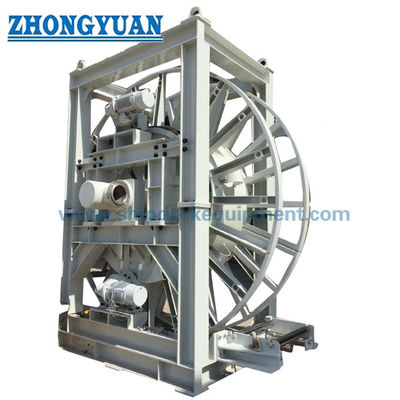
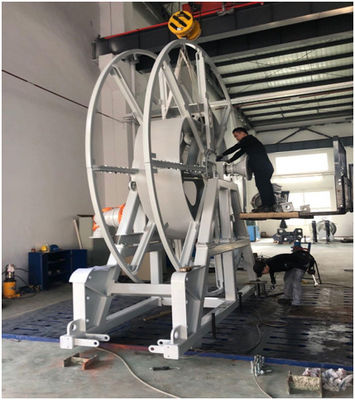
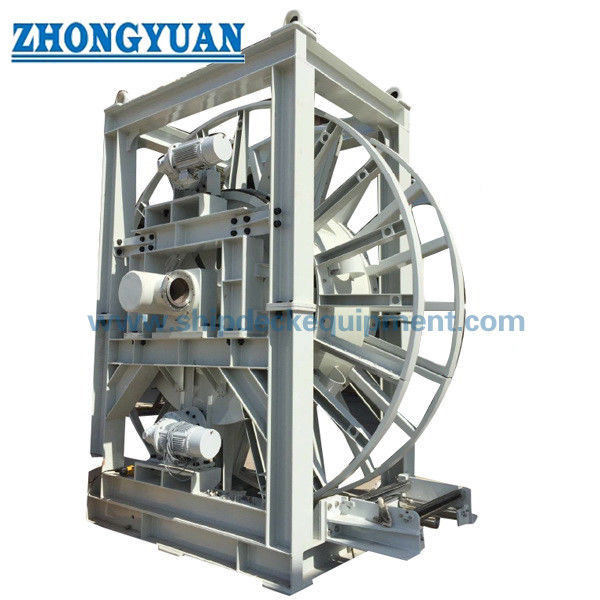
The electric offshore fire hose reel winch is a powered deck-mounted reel system for controlled storage, payout, and recovery of large-bore flexible hose used in offshore and marine firefighting or emergency water-transfer arrangements. The supplied reference configuration is intended for a Maximum 254 mm suction / delivery hose and can be arranged with a single or double drum, local and remote control, a geared electric drive, and a marine brake.
This product is different from a conventional SOLAS hydrant fire-hose reel. SOLAS fire hoses are portable hoses of limited length, while this equipment handles a much larger 254 mm hose in lengths up to the supplied 40–250 m range. For this type of reel, correct selection depends on hose outside diameter, minimum bend radius, dry and water-filled mass, coupling size, drum geometry, line pull, payout / recovery speed, brake duty, deck foundation, electrical area classification, and whether the hose must remain connected to a fluid path while rotating.
Quick Specifications
• Product type: Powered offshore fire hose reel winch → controlled storage, payout, and recovery of large-bore flexible hose.
• Reference hose size: Maximum 254 mm suction / delivery hose → actual outside diameter, minimum bend radius, coupling dimensions, and hose certificate must be confirmed.
• Hose storage range: 40–250 m → final capacity depends on hose OD, drum core diameter, flange diameter, usable width, number of layers, and coupling arrangement.
• Reference line pull: 50 kN → exact basis (first layer / outer layer, continuous / intermittent, dry or submerged hose) must be confirmed before final rating.
• Reference reel speed: 8–30 m/min → pull decreases as speed increases; 50 kN and 30 m/min should not be presented as a simultaneous continuous operating point without a verified pull-speed curve.
• Drive reference: 7.5 kW, 415 V / 50 Hz electric motor with brake → final motor and gearbox sizing must follow the confirmed duty point and mechanical efficiency.
• Control: local + remote control, wireless remote optional → emergency stop, brake logic, direction control, and fail-safe requirements should be defined by project.
• Offshore electrical protection: IP56 reference → hazardous-area use requires separate Ex / IECEx / ATEX or class-approved electrical specification where applicable.
Hose Handling & Drum Design Basis
• The drum core diameter should respect the hose manufacturer’s minimum bend radius to reduce flattening, kinking, carcass fatigue, and local damage during repeated winding cycles.
• A 254 mm hose may have large couplings and a significantly larger actual outside diameter than the nominal bore. Coupling OD and minimum straight length should therefore be checked against the drum flange and first wrap.
• The storage calculation should be based on real hose OD and usable drum width. Catalogue length alone is not sufficient for confirming 250 m capacity.
• If the hose is recovered from water, the drive and brake should be checked against suspended hose weight, water retained in the hose, hydrodynamic drag, and the changing effective drum radius.
• If the hose is intended to transfer water while being paid out or wound, a suitable rotary fluid swivel / internal flow path is required. No swivel specification was provided and this function must be confirmed separately.
• For double-drum configurations, confirm whether the drums operate independently or together and whether each drum requires its own clutch, brake, drive, or hose connection.
Drive, Pull & Speed Engineering
The supplied 50 kN pull, 8–30 m/min speed, and 7.5 kW motor should be treated as separate catalogue references until the actual duty curve is confirmed. Mechanical power at the drum is the product of line pull and line speed; therefore a high pull cannot be maintained at the maximum speed with a 7.5 kW motor.
• At 50 kN and 8 m/min, theoretical drum power is approximately 6.7 kW before gearbox, bearing, and drive losses.
• At 50 kN and 30 m/min, theoretical drum power is approximately 25 kW before losses.
• Accordingly, the 7.5 kW reference motor can only support the 50 kN pull near the low-speed end, or the 50 kN value may represent an intermittent / maximum / brake-related load rather than continuous rated pull.
• The final quotation should state rated pull, corresponding speed, drum layer, duty cycle, motor rating, gearbox ratio, and brake holding torque as a matched set of values.
Main Technical Parameters
|
Parameter |
Supplied / Recommended Reference |
Engineering Note |
|---|---|---|
| Hose nominal diameter | Maximum 254 mm | Large-bore suction / delivery hose; actual OD, MBR and couplings to be confirmed. |
| Hose storage capacity | 40–250 m | Depends on drum geometry, hose OD, coupling size and winding layers. |
| Reference line pull | 50 kN | Operating basis and drum layer to be confirmed; do not treat as an SWL. |
| Reference speed | 8–30 m/min | Final pull-speed curve to be confirmed. |
| Drum arrangement | Single / Double | Double-drum drive, clutch and brake arrangement to be confirmed. |
| Electric motor | 7.5 kW, 415 V / 50 Hz | Reference only; final motor rating depends on pull, speed and duty. |
| Brake | Marine brake | Brake type and holding torque to be confirmed. |
| Control | Local / Remote | Wireless remote optional; emergency-stop philosophy to be confirmed. |
| Control enclosure | IP56 | Ingress protection only; not an explosion-protection rating. |
| Main material | Mild steel / Stainless steel | Exact grades and mixed-material interfaces to be confirmed. |
| Surface preparation | Sa 2½ | Use project coating specification; total DFT and topcoat not supplied. |
| Coating | 3-layer epoxy system | Primer / intermediate / topcoat details and DFT to be confirmed. |
Brake, Control & Operational Safety
• The brake should hold the reel and hose under the defined static load without relying on motor torque. Required holding torque depends on the maximum effective drum radius and project load case.
• Local control should give the operator direct visibility of the drum and hose lead where practicable. Remote control should not remove the need for a safe local operating / emergency-stop arrangement.
• Direction control, emergency stop, brake release, overload protection, and motor protection should be integrated into the approved control logic.
• Wireless remote control should be treated as an optional operating interface; radio approval, fail-safe behavior, loss-of-signal response, and hazardous-area suitability are project-specific.
• Guards should prevent access to rotating drum, coupling, shaft, gear and pinch-point areas while still allowing hose inspection and maintenance.
Offshore Electrical & Hazardous-Area Considerations
IP56 indicates enclosure protection against ingress of dust and water, but it does not by itself make the motor, brake, control box, or wireless equipment suitable for a hazardous area. Where the reel is installed in a classified offshore location, the electrical equipment should be selected for the required gas group, temperature class, equipment protection level / zone, and applicable IEC 60079 / IECEx, ATEX, class, or flag requirements.
• Confirm installation area: safe area, Zone 1, Zone 2, or other project classification.
• Confirm required Ex marking for motor, brake, limit switches, junction box, control station, wireless equipment, and any sensors.
• Confirm offshore power supply, motor starting method, cable specification, grounding / bonding, heating, and low-temperature requirements.
• IEC 61892 and the IEC 60079 series can be relevant to electrical installations on offshore units when specified by the project.
Structure
Steel reel drum | Drum shaft and bearings | Gear reducer / drive train | Braked electric motor | Base frame and deck foundation interface | Local control station | Remote-control interface | Protective guards | Optional hose guide / level-wind | Optional rotary fluid swivel | Single- or double-drum arrangement
Engineering & Quality Advantages
• The reel is engineered around hose protection as well as storage capacity; drum core diameter, flange height, hose lead, and coupling clearance are checked against the actual hose rather than nominal bore alone.
• Pull, speed, motor power, and brake torque are treated as a matched drive-system calculation instead of independent catalogue values.
• Single- and double-drum layouts can be configured around vessel deck space, hose deployment direction, maintenance access, and required independent drum operation.
• For offshore installation, electrical enclosure protection, hazardous-area certification, corrosion system, and control philosophy are separated into project-specific requirements rather than assumed from a generic IP rating.
• Structural calculation, shaft / bearing check, drum stress review, foundation load calculation, and FAT can be prepared when required by the approved project and class scope.
Selection & Inquiry Guide
Step 1: Provide hose data: nominal bore, actual OD, minimum bend radius, dry mass per metre, water-filled mass, coupling OD / length, hose construction, and required fire-retardant / hose certificate.
Step 2: Confirm operating duty: storage only, powered payout / recovery, dry or water-filled hose, overboard recovery depth, required pull, required speed, and duty cycle.
Step 3: Confirm reel configuration: single or double drum, hose length per drum, drum orientation, hose lead direction, level-wind / guide requirement, and whether a rotary fluid swivel is required.
Step 4: Confirm drive and control: power supply, motor rating, brake type, local / remote / wireless control, emergency stop, and required automation / limit switches.
Step 5: Confirm offshore installation: deck GA, foundation area, safe / hazardous-zone classification, ambient temperature, corrosion environment, material and coating specification.
Step 6: Confirm inspection and commercial scope: class society, design approval / witness requirement, FAT, material certificates, quantity, destination, packing, and required delivery time.
Custom Attributes
Product Type: Offshore fire hose reel winch → powered reel for large-bore hose storage, deployment, and recovery.
Reference Hose: 254 mm suction / delivery hose → hose OD, bend radius, coupling and certification to be confirmed.
Storage Capacity: 40–250 m → calculated from actual hose and drum geometry for each project.
Reference Pull: 50 kN → rating basis and corresponding speed to be confirmed; not described as SWL.
Speed Range: 8–30 m/min → final operating speed depends on load and drive sizing.
Drive: Electric, 7.5 kW reference → final motor / gearbox to be confirmed by pull-speed duty.
Control: Local / remote / optional wireless → project-specific emergency-stop and fail-safe logic required.
Electrical Protection: IP56 reference → separate Ex certification is required where installed in a hazardous area.
Coating: Sa 2½ + 3-coat epoxy reference → final paint system and DFT follow project specification.
Class / Inspection: Available according to project requirement → approval body, drawing review and witnessing scope to be confirmed before quotation.
How It Works
Operator commands payout / recovery → Brake releases under controlled logic → Electric motor and gearbox rotate reel → Hose is paid out or wound at the selected speed → Brake stops and holds drum when commanded → Hose remains stored on the reel without using the winch as a personnel or cargo lifting appliance
Applications
Offshore support vessels | Offshore platforms and service modules | Emergency firefighting water-transfer systems | Large-bore suction / delivery hose handling | Marine response vessels | Specialized deck hose handling | Project-specific cable / hose reel configurations when separately engineered
Testing & Certification
Inspection and testing should be defined by the approved project specification. Typical scope can include dimensional inspection, no-load functional test, direction / speed test, brake test, control and emergency-stop test, electrical insulation / protection checks, and load test at the agreed pull where required. For class projects, design approval and witness scope are subject to the selected classification society and contract.
The 254 mm hose should have its own applicable hose material / fire-retardant / pressure certification according to the hose manufacturer and project requirement. This hose certification is separate from the winch’s structural, electrical, and class documentation.
Certificates can be arranged according to project requirement, inspection scope, material traceability, and class society approval procedure.
Certification: CCS, NK, BV, ABS, DNV, LR, KR, IRS, RS, RINA, CRS, Makers Test Certificate.
Drawing & Photos

FAQ
Q1: Is this the same as a normal ship fire-hose reel required by SOLAS?
A1: No. The supplied configuration is for a 254 mm large-bore suction / delivery hose with 40–250 m storage capacity. Conventional SOLAS fire hoses are much shorter portable hydrant hoses. The applicable firefighting system requirement for this large-bore hose must therefore be confirmed from the vessel or offshore project specification.
Q2: Can the 50 kN pull and 30 m/min speed be used at the same time with a 7.5 kW motor?
A2: Not as a continuous operating point based on basic mechanical power. Theoretical drum power would be about 25 kW before losses. The final winch should therefore be quoted with a confirmed pull-speed curve, gearbox ratio, duty cycle, motor power, and brake torque.
Q3: What information is most important before quotation?
A3: Provide the actual hose datasheet, hose length, OD and bend radius, dry / filled weight, coupling size, required pull and speed, single / double drum arrangement, installation zone, power supply, control method, class / FAT requirement, deck drawing, destination, and delivery time.