


|
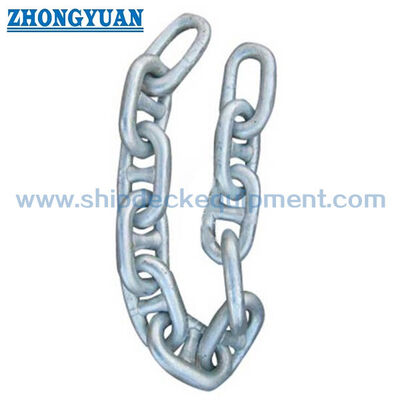
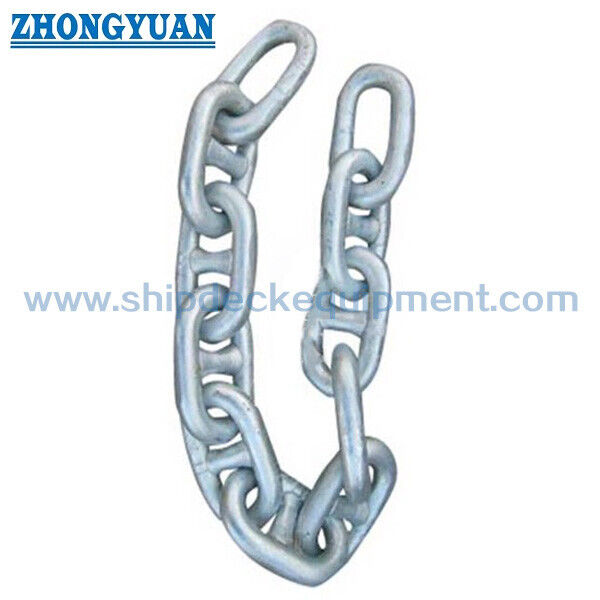
Hot-Dip Galvanized Stud Link Anchor Chain | Grade 2 & Grade 3 for Marine Anchoring
Product Details:
| Place of Origin: | China |
| Brand Name: | Zhongyuan Marine Equipmen |
| Certification: | CCS, NK, BV, ABS, DNV, LR, KR, IRS, RS, RINA, CRS, Makers Test Certificate |
| Model Number: | Standard or Customized |
Payment & Shipping Terms:
| Minimum Order Quantity: | 1 Unit |
|---|---|
| Price: | Based on quotation |
| Packaging Details: | Export standard pallet or customized packing |
| Delivery Time: | Based on project requirements |
| Payment Terms: | T/T, L/C |
| Supply Ability: | Customized production based on project requirements |
|
Detail Information |
|||
| Standard:: | IACS Class Society Rules | Grade:: | U1, U2, U3, Etc. |
|---|---|---|---|
| Chain Diameter:: | 9/16 Inch To 2 15/16 Inch | Length Per Shot:: | 25-27.5m, Customized |
| Construction:: | Flash Butt Welded, Heat Treatment, | Type:: | Stud Link; |
| Test:: | Proof Load Test, Break Load Test, Material Property Test, | Surface Treatment:: | Grit Blasting, Hot Dip Galvanize; |
| Classification Certificates:: | RINA, BV, CCS, CR, NK, ABS, DNV, LR And Mill Certificate. | Material Grade:: | CM490, CM690, 20Mn2,30Mn2 |
| Highlight: | galvanized stud link anchor chain,9/16 inch stud link anchor chain,heat treatment stud link anchor chain |
||
Product Description
Hot-Dip Galvanized Stud Link Anchor Chain | Grade 2 & Grade 3 for Marine Anchoring
Product Overview
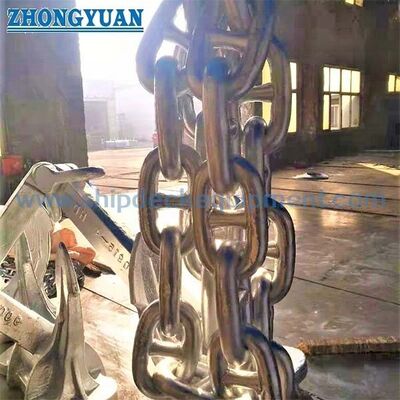
The hot-dip galvanized stud link anchor chain is a marine chain cable used between the bower anchor and the vessel anchoring system. The stud supports link geometry and helps the chain run in a controlled manner through the windlass gypsy, chain stopper, hawse pipe, and chain locker. The galvanized finish provides a zinc-based corrosion-protection layer for marine exposure, while final chain grade and diameter remain part of the vessel’s class-approved anchoring arrangement.
This page covers Grade 2 and Grade 3 stud link anchor chain in nominal imperial diameters from 9/16 in to 2 15/16 in, with flash-butt-welded links, grade-dependent heat treatment, proof-load testing, sample breaking-load testing, and optional matching accessories. A 27.5 m shot is the normal class-rule reference length; 25 m or other lengths can be discussed when the assembly, testing, marking, and certificate scope are agreed before production. Stud fixing or stud welding must follow the approved design and cannot be determined only from whether the chain is Grade 2 or Grade 3.
Quick Specifications
- Product type: Galvanized stud link anchor chain → marine chain cable for vessel anchoring systems, not a general lifting chain.
- Primary grades: Grade 2 / U2 and Grade 3 / U3 → select according to vessel equipment number, anchor arrangement, applicable class rules, and approved drawings.
- Diameter range: 9/16 in to 2 15/16 in, approximately 14–75 mm → final nominal metric size and chain geometry should be confirmed before quotation.
- Manufacturing route: Flash-butt-welded links with grade-appropriate heat treatment → weld quality, dimensional control, and material traceability are key acceptance items.
- Supply length: 27.5 m per shot as the normal class-rule reference; 25 m and customized lengths subject to assembly and certification confirmation.
- Load verification: Proof-load test for finished chain lengths and breaking-load test on representative samples → test loads are acceptance values, not SWL.
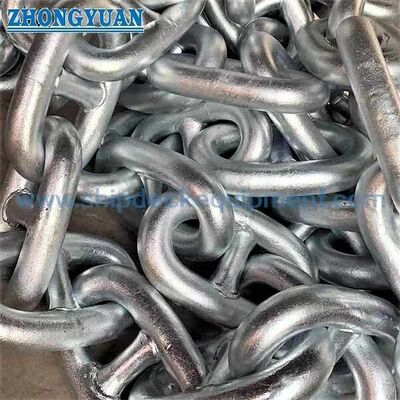
- Corrosion protection: Hot-dip galvanized finish as the main option → coating system, thickness, process sequence, and class acceptance should be specified in the order.
- Accessories: Joining shackles, anchor shackles, swivels, swivel forerunners, enlarged links, and end links can be supplied as a matched assembly when specified.
Main Technical Parameters
| Diameter Of Anchor Chain |
Grade 2 | Grade 3 | ||
| Proof Load | Breaking Load | Proof Load | Breaking Load | |
| Inch | Ibf | Ibf | Ibf | Ibf |
| 9/16 | 19300 | 27000 | 27000 | 38600 |
| 5/8 | 23700 | 33200 | 33200 | 47500 |
| 11/16 | 28600 | 40100 | 40100 | 57300 |
| 3/4 | 34000 | 47600 | 47600 | 68000 |
| 13/16 | 39800 | 55700 | 55700 | 79500 |
| 7/8 | 46000 | 64400 | 64400 | 91800 |
| 15/16 | 52600 | 73700 | 73700 | 105000 |
| 1 | 59700 | 83600 | 83600 | 119500 |
| 1 | 67200 | 94100 | 94100 | 135000 |
| 1 1/8 | 75000 | 105000 | 105000 | 150000 |
| 1 1/5 | 83400 | 116500 | 116500 | 167000 |
| 1 1/4 | 92200 | 129000 | 129000 | 184000 |
| 1 1/3 | 101500 | 142000 | 142000 | 203000 |
| 1 3/8 | 111000 | 155000 | 155000 | 222000 |
| 1 4/9 | 120500 | 169000 | 169000 | 241000 |
| 1 1/2 | 131000 | 183500 | 183500 | 262000 |
| 1 4/7 | 142000 | 198500 | 198500 | 284000 |
| 1 5/8 | 153000 | 214000 | 214000 | 306000 |
| 1 11/16 | 166500 | 229000 | 229000 | 327000 |
| 1 3/4 | 176000 | 247000 | 247000 | 352000 |
| 1 13/16 | 188500 | 264000 | 264000 | 377000 |
| 1 7/8 | 201000 | 281000 | 281000 | 402000 |
| 1 15/16 | 214000 | 299000 | 299000 | 427000 |
| 2 | 227000 | 318000 | 318000 | 454000 |
| 2 1/16 | 241000 | 337000 | 337000 | 482000 |
| 2 1/8 | 255000 | 357000 | 357000 | 510000 |
| 2 3/16 | 269000 | 377000 | 377000 | 538000 |
| 2 1/4 | 284000 | 396000 | 396000 | 570000 |
| 2 5/16 | 299000 | 418000 | 418000 | 598000 |
| 2 3/8 | 314000 | 440000 | 440000 | 628000 |
| 2 7/16 | 330000 | 462000 | 462000 | 660000 |
| 2 1/2 | 346000 | 484000 | 484000 | 692000 |
| 2 9/16 | 363000 | 507000 | 507000 | 726000 |
| 2 5/8 | 379000 | 530000 | 530000 | 758000 |
| 2 11/16 | 396000 | 554000 | 554000 | 792000 |
| 2 3/4 | 413000 | 578000 | 578000 | 826000 |
| 2 13/16 | 431000 | 603000 | 603000 | 861000 |
| 2 7/8 | 449000 | 628000 | 628000 | 897000 |
| 2 15/16 | 467000 | 654000 | 654000 | 934000 |
Grade, Load & Selection Basis
- Grade 2 selection: Special-quality anchor chain is commonly used where the class-approved anchoring equipment table specifies Grade 2 chain for the required equipment number and diameter.
- Grade 3 selection: Extra-special-quality chain carries higher specified proof and breaking loads at the same nominal diameter, but any diameter reduction must be supported by the vessel design and class approval.
- Proof load: A non-destructive acceptance load applied to the finished chain length using an approved testing machine; it is not the chain SWL.
- Breaking load: A destructive qualification or production sample test load applied to representative links according to the applicable rule and survey plan; it is not a routine service load.
- System compatibility: Chain diameter, pitch, width, accessories, windlass gypsy pockets, chain stopper, hawse pipe, chain locker, and anchor connection must be checked as one anchoring system.
Manufacturing, Heat Treatment & Quality Controls
- Stud link chain is preferably manufactured from approved bar material by flash-butt welding, with the weld upset and flash removed to the accepted profile.
- Heat treatment is selected by chain grade and approved material route. Grade 2 may be supplied in an approved as-welded or normalized condition, while Grade 3 requires the specified normalized, normalized-and-tempered, or quenched-and-tempered condition.
- Studs should fit the link internally without an appreciable gap and remain correctly positioned. Where stud welding is part of the approved design, welding procedure, consumables, welder qualification, weld location, and heat-treatment sequence must be controlled.
- Link diameter, pitch, width, stud position, five-link length, and accessory fit are checked against the selected recognized standard or approved drawing after the relevant production and proof-loading stages.
- Visual examination focuses on the flash-butt weld, crown, stud area, and transitions. Non-destructive examination is arranged where required by the applicable class rule, approved manufacturing procedure, or survey plan.
- Heat number, material grade, chain grade, diameter, production batch, heat-treatment batch, test record, marking, and certificate identity should remain traceable through the delivery package.
Galvanizing & Corrosion Protection
- Hot-dip galvanizing provides a zinc coating over the chain surface and is suitable when the owner or shipyard requires improved corrosion protection compared with an uncoated or temporary painted finish.
- The galvanizing route, surface preparation, coating mass or thickness, centrifuging or drainage method, touch-up limits, and acceptance criteria should be agreed before production. The process sequence must not interfere with required visual examination, proof testing, breaking-load sampling, identification, or class survey.
- Zinc coating can wear locally at the windlass gypsy, chain stopper, hawse pipe, seabed-contact zones, and link-to-link bearing areas. Galvanizing therefore reduces corrosion exposure but does not remove the need for periodic inspection and maintenance.
- Electro-galvanized or other zinc finishes can be discussed for specific chain sizes or accessories, but they should not be treated as equivalent to hot-dip galvanizing unless the required coating system is clearly specified and accepted.
Testing, Inspection & Certification
- Finished chain shots are proof-load tested at the load corresponding to chain diameter and grade using an approved testing machine. Surveyor attendance applies when required for the ordered class certificate.
- Breaking-load testing is performed on representative sample links according to the applicable rule and production sampling plan. The sample test does not mean that every delivered link is destructively tested.
- Grade 2 and Grade 3 chain may require tensile, impact, or other mechanical tests from production-linked test material according to the selected class rule, material grade, and heat-treatment condition.
- Dimensional inspection, visual inspection, marking, and documentation review form part of the acceptance process. NDT scope is confirmed by the approved manufacturing procedure and class requirement.
- Available documentation may include the class product certificate, material or mill certificate, maker test report, proof-load record, breaking-load test record, mechanical test results, dimensional report, heat-treatment record, and galvanizing record, according to the agreed order scope.
Selection & Inquiry Guide
Step 1: Confirm vessel type, newbuilding or replacement scope, applicable classification society, equipment number or approved anchoring arrangement, anchor mass, required chain grade, and nominal diameter.
Step 2: Confirm chain standard or approved drawing, metric / imperial designation, shot length, number of shots, port and starboard allocation, and whether the chain must match an existing windlass gypsy and chain stopper.
Step 3: Confirm material grade and delivery condition, stud fixing or stud-welding arrangement, heat-treatment requirement, hot-dip galvanizing specification, and any coating-thickness or appearance requirement.
Step 4: Define the complete chain assembly: common links, enlarged links, end links, Kenter or joining shackles, anchor shackle, swivel, swivel forerunner, bitter-end connection, and spare accessories.
Step 5: Confirm inspection and certification scope before quotation: class certificate, surveyor witnessing, proof and breaking tests, mechanical tests, NDT, material traceability, marking, and document language.
Step 6: Provide quantity, required delivery time, delivery destination, packing requirement, approved drawing or existing-chain measurements, and clear photos of the anchor, windlass gypsy, chain stopper, and connection fittings when available.
Chain Assembly & Accessories
Common stud links | Enlarged links | End links | Kenter or joining shackles | Anchor shackle | Swivel | Swivel forerunner | Bitter-end connection | Matching spare accessories
Custom Attributes
- Chain Grade: Grade 2 / U2 or Grade 3 / U3 → final notation and acceptance criteria follow the selected classification society.
- Nominal Diameter: 9/16 in to 2 15/16 in → confirm the corresponding metric nominal size and approved chain geometry.
- Shot Length: 27.5 m reference; 25 m or customized length available for discussion → certificate and test scope must match the supplied assembly.
- Manufacturing: Flash-butt-welded stud links → weld profile, dimensional repeatability, and material traceability are controlled production points.
- Heat Treatment: According to chain grade and approved material route → final delivery condition to be stated on the quotation and certificate.
- Stud Arrangement: Approved fitted or welded configuration → do not select stud welding solely from Grade 2 or Grade 3 terminology.
- Material: CM490, CM690, 20Mn2, 30Mn2, or approved equivalent as stated by the supplier → exact grade-to-chain-grade mapping requires confirmation.
- Surface Finish: Hot-dip galvanized as primary option → electro-galvanized, painted, or alternative finish only when specified and accepted.
- Testing: Proof load, sample breaking load, mechanical tests, dimensional inspection, and additional NDT as applicable → scope follows class and order requirements.
- Certificates: Class product certificate, material certificate, and maker test report available according to the approved order scope.
How It Works
Anchor is released from the vessel → Stud link chain pays out through the windlass and hawse pipe → Studs support link geometry and controlled engagement with the gypsy → Chain transmits anchoring force between the anchor and the vessel → Windlass recovers the chain into the chain locker
Applications
Merchant vessels | Tugboats | Workboats | Fishing vessels | Patrol and service craft | Coastal and harbor vessels | Newbuilding anchor systems | Class-approved replacement anchor-chain projects
Certifications & Supply Scope
Certificates can be arranged according to the selected classification society, approved manufacturer scope, survey plan, material traceability, test witnessing, and project requirement. Accessories and certificate coverage should be confirmed as part of the complete chain assembly before quotation.
Certification: CCS, NK, BV, ABS, DNV, LR, KR, IRS, RS, RINA, CRS, Makers Test Certificate.
Drawing & Photos

FAQ
Q1: How should Grade 2 or Grade 3 anchor chain be selected?
A1: Selection starts from the vessel equipment number, anchor arrangement, applicable class rules, and approved anchoring plan. Grade 3 has higher specified proof and breaking loads at the same diameter, but it must not be used to reduce chain size unless the vessel designer and class approve the complete anchoring system.
Q2: Does Grade 2 always use an unwelded stud while Grade 3 uses a welded stud?
A2: No universal grade-only rule should be used for this decision. Stud fixing, stud welding, weld position, welding procedure, and heat-treatment sequence depend on the approved chain design, manufacturing procedure, and classification-society requirements.
Q3: What information is required for an accurate quotation?
A3: Confirm class society, chain grade, nominal diameter, shot length and quantity, vessel and anchor data, windlass-gypsy compatibility, hot-dip galvanizing requirement, accessories, testing and certificate scope, delivery destination, and required delivery time. Existing assembly drawings or measured photos are particularly useful for replacement projects.