


|
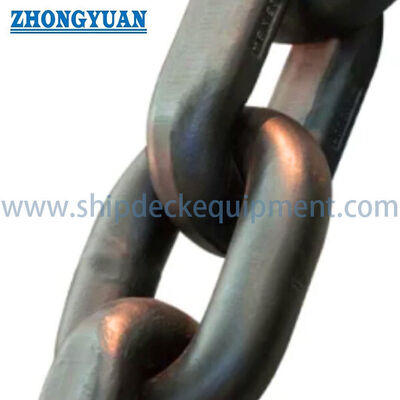
High-Tensile Round Link Mining Chain | Grade B & C Conveyor Chain 14-34 mm
Product Details:
| Place of Origin: | China |
| Brand Name: | Zhongyuan Marine Equipmen |
| Certification: | CCS, NK, BV, ABS, DNV, LR, KR, IRS, RS, RINA, CRS, Makers Test Certificate |
| Model Number: | Standard or Customized |
Payment & Shipping Terms:
| Minimum Order Quantity: | 1 Unit |
|---|---|
| Price: | Based on quotation |
| Packaging Details: | Export standard pallet or customized packing |
| Delivery Time: | Based on project requirements |
| Payment Terms: | T/T, L/C |
| Supply Ability: | Customized production based on project requirements |
|
Detail Information |
|||
| Structure: | Flash Butt Welded Chain | Material: | Alloy,Carbon Steel |
|---|---|---|---|
| Color: | Solid Color | Feature: | Heat Resistant |
| Surface Treatment: | Baking Paint Etc | Usage: | Mining Chain |
| Highlight: | High Toughness Mining Chain,Grade B Mining Chain |
||
Product Description
High-Tensile Round Link Mining Chain | Grade B & C Conveyor Chain 14-34 mm
Product Overview
This high-tensile round link mining chain is a flash-butt-welded traction chain for continuous conveyors and winning equipment used in coal mining and similar heavy-duty mineral handling systems. Typical installations include scraper conveyors, armored face conveyors, stage loaders, roadheaders, coal ploughs, and shearer-related traction systems. The chain is designed to engage with matched drive sprockets and to transmit cyclic pulling force through calibrated round links.
The supplied range covers nominal chain sizes from 14 × 50 mm to 34 × 126 mm, with Grade B and Grade C proof/test forces and minimum breaking forces. Selection must not be based on diameter or breaking force alone. The ordered chain must match the equipment drawing, sprocket pocket geometry, pitch, strand arrangement, scraper spacing, chain length, matched-length requirement, operating environment, and the inspection standard. This product is not a lifting chain, sling chain, or suspension chain.
Quick Specifications
- Product type: High-tensile round link mining chain → traction element for scraper conveyors and mining machinery, not for lifting.
- Construction: Flash-butt-welded and calibrated round links → weld integrity, pitch accuracy, link geometry, and heat-treatment consistency are key quality points.
- Supplied size range: 14 × 50 to 34 × 126 mm → nominal chain identity is expressed as link diameter d × pitch p.
- Strength grades: Grade B and Grade C in the supplied table → grade selection follows the equipment design and specified mechanical-performance standard.
- Proof/test force range: 150 to 1160 kN → verification force used for chain testing; it is not a safe working load.
- Minimum breaking force range: 190 to 1450 kN → destructive-test acceptance value; it is not an allowable operating load.
- Reference standards: GB/T 12718-2009, ISO 610:1990, DIN 22252, or project specification → the exact governing standard must be confirmed for each order.
- Material and finish: 25MnV or suitable Cr-Ni-Mo alloy steel, with natural, painted, or project-specified surface condition → exact grade, heat treatment, and coating require confirmation.
Main Technical Parameters
| Diameter |
Inside Length |
Outside Width |
Proof Load | Breaking Load |
Approx Weight |
||
| Gr(B) | Gr(C) | Gr(B) Min |
Gr(C) Min |
||||
| mm | mm | mm | kN | kN | kN | kN | kg/m |
| 14 | 50±0.5 | 48 | 150 | 200 | 190 | 250 | 4 |
| 18 | 64±0.6 | 60 | 260 | 330 | 320 | 410 | 6.6 |
| 22 | 86±0.9 | 74 | 380 | 49o | 480 | 610 | 9.5 |
| 24 | 86±0.9 | 79 | 460 | 580 | 570 | 720 | 11.6 |
| 24 | 87.5±0.9 | 79 | 460 | 580 | 570 | 720 | 11.5 |
| 26 | 92±0.9 | 86 | 540 | 680 | 670 | 850 | 13.7 |
| 30 | 108±1.0 | 98 | 710 | 9oo | 89o | 1130 | 18 |
| 34 | 126±1.2 | 109 | 9o0 | 1160 | 1140 | 1450 | 24.1 |
Load Terminology and Grade Selection
- Proof / Test Force: The specified verification force applied during testing to confirm that the chain meets the ordered grade requirement. It is not SWL, WLL, or permissible operating load.
- Minimum Breaking Force: The minimum destructive-test force required by the selected standard or agreed specification. It must not be used directly as the conveyor design load.
- Grade B and Grade C: Mechanical-performance grades defined by proof/test force, breaking force, elongation, fatigue, and other standard requirements. Grade is not determined by surface hardness alone.
- System Design Load: Determined by the conveyor or equipment designer using chain pull, dynamic loading, start-up shock, strand arrangement, sprocket condition, wear allowance, service factor, and operating duty.
- Grade D, compact chain, flat link chain, and reinforced chain: Separate configurations requiring their own dimensions, mechanical tables, and approval basis; they are not included in this Grade B/C round-link table.
Selection & Inquiry Guide
Step 1: Confirm the governing standard, nominal chain size d × p, Grade B or Grade C, and whether the order is for a complete new chain system or a replacement chain.
Step 2: Provide the equipment type and model, drive arrangement, number of chain strands, sprocket drawing or pocket dimensions, connector type, and existing chain marking if available.
Step 3: Confirm total chain length or number of links, matched-pair requirement, scraper flight spacing, attachment arrangement, chain centre distance, and permissible length tolerance.
Step 4: Confirm steel grade, heat-treatment requirement, required surface condition, underground corrosion conditions, operating temperature, abrasive material, and maintenance practice.
Step 5: Confirm inspection scope: dimensional inspection, proof/test force, breaking-force sampling, elongation, bend/deflection, fatigue testing, material analysis, weld and heat-treatment traceability, and third-party witnessing if required.
Step 6: Provide quantity, packing method, destination mine or country, required delivery date, replacement urgency, and photos or drawings of the existing chain, sprocket, scraper, and connector.
Manufacturing and Heat-Treatment Control
- Round bar is formed into the specified link geometry and joined by flash-butt welding. The weld upset, trimming, weld position, and heat-affected area must be controlled without reducing the required link section.
- Link calibration controls pitch, outside width, twist, and overall geometry so the chain can engage consistently with the specified sprocket pocket and scraper arrangement.
- Heat treatment is selected to achieve the ordered balance of strength, toughness, fatigue resistance, and wear performance. The exact cycle, hardness limits, and hardness distribution must follow approved manufacturing data.
- Proof loading and dimensional inspection identify unacceptable permanent deformation, weld defects, or geometry outside the ordered tolerance before release.
- For twin-strand or matched-chain systems, paired lengths should be measured and supplied according to the specified setting force, measuring length, and matching tolerance.
- Field repair welding, local heating, uncontrolled grinding, or re-heat treatment can change the chain's mechanical performance and should not be carried out without an approved OEM or manufacturer procedure.
Sprocket Compatibility, Wear and Service Life
- Diameter d, pitch p, inside width, outside width, and link profile must match the drive sprocket and chain guide geometry. A nominally similar chain can still be incompatible if the pocket form or pitch differs.
- A new chain installed on severely worn sprockets can experience poor seating, impact loading, accelerated pitch wear, and uneven load distribution. Replacement planning should assess chain and sprockets as one system.
- Twin-strand conveyors require controlled matched length to prevent one strand from carrying a disproportionate share of the load.
- Inspection should focus on pitch elongation, diameter loss at interlink contact areas, weld condition, bent or twisted links, corrosion, scraper connection points, and abnormal sprocket engagement.
- Lubrication, cleaning, chain tension, and replacement limits should follow the conveyor OEM and mine maintenance procedure; they should not be assumed from chain size alone.
Product Configuration Attributes
- Reference Standard: GB/T 12718-2009 / ISO 610:1990 / DIN 22252 / project specification → final compliance basis to be stated in the purchase order.
- Chain Form: Calibrated round link chain → this page does not cover compact, flat-link, or lifting chain.
- Strength Grade: Grade B or Grade C → select according to equipment design, standard, fatigue duty, and replacement requirement.
- Size Range: 14 × 50 to 34 × 126 mm in the supplied table → additional sizes require separate technical confirmation.
- Manufacturing Method: Flash-butt-welded links → welding, trimming, calibration, and heat treatment are controlled production stages.
- Material: 25MnV or suitable Cr-Ni-Mo alloy steel → exact grade and mill certificate to be confirmed.
- Supply Length: Specified number of links, chain length, or matched pair → measuring condition and tolerance must be agreed.
- Surface Condition: Natural, painted, or project-specified corrosion-protection system → coating must not be treated as a substitute for metallurgical wear performance.
- Documentation: Material certificate, dimensional report, mechanical test report, batch traceability, and third-party inspection → available according to the agreed order scope.
How It Works
Drive sprocket applies torque to the calibrated chain → Round links engage with the sprocket pockets → Chain pull moves scraper flights or the connected mining mechanism → Cyclic tensile force passes through the interlinked and flash-butt-welded links → Return strand completes the conveyor circuit → Tension, wear, sprocket engagement, and chain elongation are monitored during service
Applications
Armored face conveyors (AFC) | Beam stage loaders (BSL) | Underground scraper conveyors | Scraper transfer conveyors | Roadheader traction systems | Coal plough systems | Drum shearer-related traction equipment | Mining conveyor replacement projects
Testing, Inspection and Documentation
The inspection plan should be agreed before production and linked to the selected standard, chain grade, batch size, and mine or equipment approval requirement.
- Dimensional inspection: diameter, pitch, inside/outside width, weld position, link twist, chain length, and matched-pair length.
- Mechanical verification: proof/test force, minimum breaking force, elongation, bend or deflection, and fatigue test when required by the governing standard.
- Material and process records: steel grade, chemical analysis, mechanical properties, heat-treatment batch, weld-process traceability, and hardness data when specified.
- Release documents: maker test report, material certificate, dimensional report, batch identification, packing list, and third-party inspection certificate according to order scope.
- Mining safety approval, mine acceptance, or market-specific certification is subject to the destination, equipment application, and supplier qualification; it is not implied as standard supply.
Drawing & Photos

FAQ
Q1: Can this mining chain be used for lifting, slings, or suspended loads?
A1: No. The round link chain covered by GB/T 12718 and ISO 610 is intended for mining conveyor and traction applications, not for lifting appliances, chain slings, or suspension service.
Q2: How should Grade B or Grade C be selected?
A2: Use the conveyor or mining-machine OEM requirement, governing standard, chain pull calculation, dynamic duty, fatigue requirement, sprocket design, and existing system grade. Do not select a grade only by comparing minimum breaking force.
Q3: What information is required for a reliable replacement-chain quotation?
A3: Provide the standard, chain marking, size d × p, grade, equipment model, number of strands, total length or link count, matched-length requirement, scraper spacing, sprocket and connector details, required tests, quantity, destination, and clear photos or drawings.