


|
Four-Roller Universal Fairlead with Upper Roller | ISO 13733 Type 4R for Ship Mooring and Towing
Product Details:
| Place of Origin: | China |
| Brand Name: | Zhongyuan Marine Equipmen |
| Certification: | CCS, NK, BV, ABS, DNV, LR, KR, IRS, RS, RINA, CRS, Makers Test Certificate |
| Model Number: | Standard or Customized |
Payment & Shipping Terms:
| Minimum Order Quantity: | 1 Unit |
|---|---|
| Price: | Based on quotation |
| Packaging Details: | Export standard pallet or customized packing |
| Delivery Time: | Based on project requirements |
| Payment Terms: | T/T, L/C |
| Supply Ability: | Customized production based on project requirements |
|
Detail Information |
|||
| Model Type: | 4R, 4 Rollers | Function: | Mooring And Towing |
|---|---|---|---|
| Nominal Size: | 140, 160, 180, 200, 250, 300A, 300B, 400A, 400B And 400C | Safe Working Load (SWL): | 14~140MT |
| Load Direction: | Horizontal Load And Vertical Load | Materials: | C-Mn Steel, Mild Steel, Stainless Steel |
| Surface Treatment: | Sandblasting To S2.5 + One Layer Of Epoxy Shop Primer, Polished, Galvanized, Customized Surface Treatment Available | Classification Certificates: | CCS, NK, BV, ABS, DNV, LR, KR, IRS, RS, RINA |
| Highlight: | ISO 13733 Ship Towing Equipment,Universal fairleads with upper roller,ISO 13733 fairleads with upper roller |
||
Product Description
Four-Roller Universal Fairlead with Upper Roller | ISO 13733 Type 4R for Ship Mooring and Towing
Product Overview
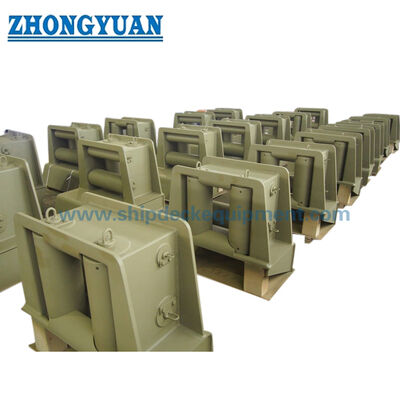
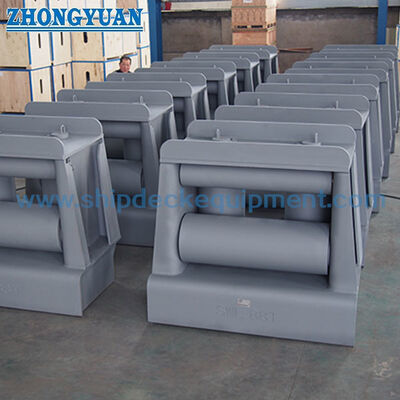
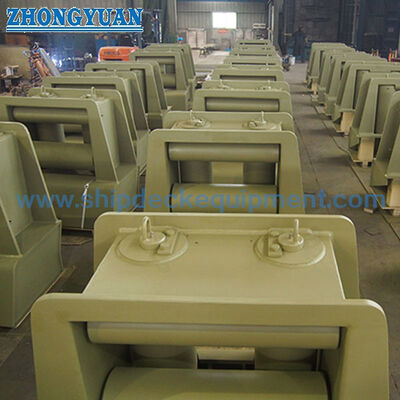
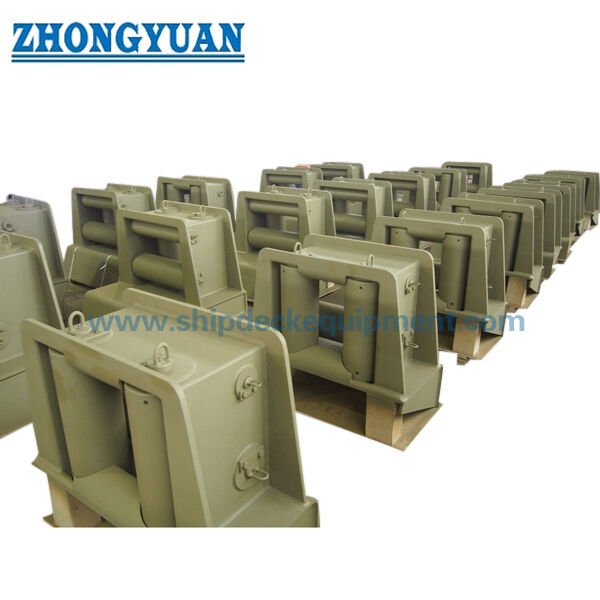
The ISO 13733 Type 4R universal fairlead is a deck-mounted ship mooring and towing rope guide with two vertical rollers and two horizontal rollers arranged around one enclosed rope-passing opening. The upper horizontal roller helps control upward rope movement, while the vertical rollers guide port-and-starboard lead changes and the lower roller supports the rope as it passes between the vessel deck and the outboard working direction.
The supplied range covers nominal sizes 140 to 400C with reference SWL values from 137 to 1,373 kN (14 to 140 ton). Selection should not be based on SWL alone. The vessel mooring or towing arrangement, rope type and diameter, horizontal and vertical lead direction, roller contact radius, deck foundation, welding details, inspection scope, and final load marking should be confirmed before production.
Quick Specifications
- Product type: Type 4R universal fairlead with upper roller → two vertical and two horizontal rollers form one controlled rope-passing opening.
- Application: Ship mooring and towing rope guidance → final towing duty, dynamic load basis, and operating lead angle should be confirmed by the vessel designer.
- Nominal size range: 140 / 160 / 180 / 200 / 250 / 300A / 300B / 400A / 400B / 400C → nominal size is associated with the main roller outside-diameter series.
- Reference SWL range: 137 to 1,373 kN (14 to 140 ton) → use the supplied standard-table value together with the approved load direction and deck foundation design.
- Rope opening range: 195 × 150 to 350 × 250 mm → confirms the clear passage geometry for rope routing and drawing coordination.
- Calculated weight range: 159 to 2,114 kg → relevant to handling, transport, installation planning, and deck erection procedure.
- Installation: Deck-welded fabricated structure → welding leg length, supporting structure, and local reinforcement shall match the approved vessel drawing.
- Manufacturing focus: free roller rotation, aligned shafts, smooth rope-contact surfaces, controlled welding distortion, and traceable material / inspection scope.
Main Technical Parameters
| Nominal size Dn |
B x H | D1 | D2 | h | h1 | h2 | b | b1 | b2 | b3 | b4 | w | c | |
| 140 | 195 x 150 | 139,8 | 114,3 | 277 | 130 | 480 | 335 | 515 | 656 | 820 | 140 | 260 | 150 | |
| 160 | 200 x 150 | 165,2 | 114,3 | 290 | 145 | 515 | 365 | 570 | 730 | 920 | 140 | 310 | 175 | |
| 180 | 200 x 150 | 190,7 | 139,8 | 315 | 155 | 560 | 391 | 620 | 800 | 1000 | 140 | 360 | 200 | |
| 200 | 200 x 150 | 216,3 | 139,8 | 328 | 170 | 590 | 416 | 675 | 896 | 1110 | 140 | 410 | 225 | |
| 250 | 250 x 200 | 267,4 | 165,2 | 416 | 195 | 715 | 517 | 825 | 1 046 | 1270 | 180 | 520 | 280 | |
| 300A | 300 x 250 | 318,5 | 216,3 | 517 | 220 | 870 | 618 | 980 | 1 206 | 1480 | 200 | 620 | 330 | |
| 300B | 300 x 250 | 318,5 | 216,3 | 517 | 220 | 870 | 618 | 980 | 1 206 | 1480 | 200 | 620 | 330 | |
| 400A | 350 x 250 | 406,4 | 216,3 | 561 | 265 | 960 | 756 | 1 210 | 1 450 | 1750 | 200 | 795 | 420 | |
| 400B | 350 x 250 | 406,4 | 216,3 | 561 | 265 | 960 | 756 | 1 210 | 1 450 | 1750 | 200 | 795 | 420 | |
| 400C | 350 x 250 | 406,4 | 216,3 | 561 | 265 | 960 | 756 | 1 210 | 1 450 | 1750 | 200 | 795 | 420 | |
| Nominal size Dn |
e | w1 | w2 | T | T1 | T2 | T3 | T4 | f | Welding leg length z1 |
Welding leg length z2 |
SWL (kN) |
SWL (ton) |
Weight (kg) |
| 140 | 70 | 30 | 100 | 12 | 10 | 10 | 12 | 12 | 3 | 7 | 4 | 137 | 14 | 159 |
| 160 | 83 | 40 | 100 | 14 | 10 | 14 | 14 | 14 | 4 | 7 | 5 | 196 | 20 | 218 |
| 180 | 95 | 40 | 100 | 16 | 10 | 14 | 16 | 16 | 4 | 7 | 5 | 245 | 25 | 279 |
| 200 | 108 | 50 | 100 | 18 | 12 | 16 | 18 | 18 | 6 | 9 | 7 | 314 | 32 | 373 |
| 250 | 133 | 65 | 200 | 22 | 16 | 18 | 20 | 20 | 6 | 11 | 7 | 510 | 52 | 730 |
| 300A | 159 | 80 | 200 | 24 | 20 | 22 | 24 | 22 | 7 | 14 | 8 | 687 | 70 | 1173 |
| 300B | 159 | 80 | 200 | 26 | 22 | 24 | 24 | 22 | 8 | 15 | 9 | 736 | 75 | 1267 |
| 400A | 203 | 100 | 200 | 26 | 22 | 22 | 32 | 28 | 7 | 15 | 8 | 981 | 100 | 1710 |
| 400B | 203 | 100 | 200 | 28 | 24 | 26 | 32 | 28 | 8 | 17 | 9 | 1 256 | 128 | 1958 |
| 400C | 203 | 100 | 200 | 30 | 26 | 28 | 32 | 28 | 8 | 18 | 9 | 1 373 | 140 | 2114 |
Selection & Inquiry Guide
Step 1: Confirm ISO 13733 Type 4R and select nominal size 140 to 400C according to the vessel mooring / towing arrangement and approved fitting schedule.
Step 2: Confirm rope type, rope diameter, minimum bending-radius requirement, expected rope lead angle, and whether horizontal, vertical, or combined directional loading must be considered.
Step 3: Confirm the required SWL and load basis. For 300 and 400 roller series, state the correct A / B / C load variant rather than selecting by roller diameter alone.
Step 4: Provide the deck arrangement, foundation / reinforcement drawing, welding interface, installation position, and available surrounding clearance.
Step 5: Confirm material grades for the fabricated body, rollers, shafts, bushes or bearings, together with material traceability and any low-temperature or ice-service requirement.
Step 6: Confirm coating system, roller-contact surface finish, lubrication / maintenance arrangement, class inspection, test or calculation requirement, and final SWL marking.
Step 7: Provide quantity, vessel type, newbuilding or replacement status, delivery destination, required delivery time, and reference drawing or photos if available.
Structure
Two vertical rollers | Upper horizontal roller | Lower horizontal roller | Enclosed rope-passing opening | Main and secondary roller shafts | Bush / bearing arrangement to be confirmed | Fabricated deck seat and supporting plates | Deck-welded foundation interface
Roller, Welding & Engineering Advantages
- The four-roller arrangement guides the rope across both horizontal and vertical changes in lead direction, reducing direct contact with fixed steel edges.
- The upper horizontal roller controls upward rope movement and helps retain the rope within the defined passage when the lead direction varies during mooring or towing operations.
- A / B / C variants at the same nominal roller diameter provide different load capacities without changing the basic nominal size; the exact variant must therefore be stated in the inquiry.
- Roller shafts and supporting plates should be aligned so that each roller rotates freely under rope contact without binding, abnormal side contact, or local interference.
- Rope-contact surfaces should be smooth and free from sharp edges, weld spatter, harmful irregularities, or coating build-up that could abrade the rope.
- The welded seat transfers fairlead reactions into the ship structure. Deck plate thickness, foundation brackets, local reinforcement, weld size, and inspection method should be checked by the shipyard or vessel design office.
- For towing duty, the operating load spectrum, dynamic effects, rope lead changes, and emergency operating condition may differ from normal mooring duty and should be confirmed in the approved project documentation.
Custom Attributes
- Standard: ISO 13733 → edition and project acceptance to be confirmed against the purchaser’s specification.
- Type: 4R → four rollers arranged as two vertical and two horizontal rollers around one rope-passing opening.
- Nominal Size: 140 to 400C → related to the main roller outside-diameter series; letter suffix identifies different SWL variants.
- Reference SWL: 137 to 1,373 kN → final selected and marked SWL should follow the approved load case and project agreement.
- Load Direction: Horizontal and vertical rope lead → allowable direction, angle, and combined loading condition require drawing confirmation.
- Material: C-Mn steel / mild steel / stainless steel options → exact component material schedule and weldability requirement to be confirmed.
- Installation: Deck welded → foundation, reinforcement, weld size, and inspection scope form part of the vessel structural design.
- Surface Treatment: Sa 2.5 blasting plus epoxy shop primer as reference → final coating, galvanized option, or stainless-steel finish follows the order specification.
- Certificate Requirement: Available according to project scope → class survey, material certificates, maker documentation, and witness requirements should be agreed before quotation.
How It Works
Mooring or towing rope approaches the fairlead → Vertical rollers control lateral lead → Lower and upper horizontal rollers control downward / upward lead → Rope passes through the enclosed opening with rolling contact → Fairlead reactions transfer through the welded seat into the reinforced deck structure
Applications
Ship mooring stations | Towing lead positions | Tug and workboat deck arrangements | Cargo vessels | Tankers | Offshore support vessels where project specification permits | Newbuilding projects | Replacement fairlead installations
Certifications & Advantages
Certificates and inspection documentation can be arranged according to project requirement, material traceability, approved drawing, test / calculation scope, and classification society procedure.
Certification: CCS, NK, BV, ABS, DNV, LR, KR, IRS, RS, RINA, CRS, Makers Test Certificate.
Drawing & Photos

FAQ
Q1: What is the difference between Type 4R and a simpler two-roller fairlead?
A1: Type 4R uses two vertical and two horizontal rollers around one enclosed opening, so it can guide changes in both lateral and vertical rope lead. A two-roller arrangement normally controls fewer lead directions and should not be treated as an interchangeable structure without checking the vessel drawing.
Q2: Why do 300 and 400 nominal sizes have A / B / C variants?
A2: The letter suffix identifies different reference SWL levels for fairleads using the same main roller diameter and rope-opening size. The inquiry must state the complete model, such as 300A, 300B, 400A, 400B, or 400C.
Q3: Can the fairlead be selected only by the SWL table?
A3: No. Selection should also confirm rope type and diameter, minimum bend requirement, lead angle and load direction, mooring or towing duty, deck foundation, welding details, class requirement, and the final approved load marking.