


 |
Super Cell Rubber Fender for Ports and Marine Terminals
Product Details:
| Place of Origin: | China |
| Brand Name: | Zhongyuan Marine Equipmen |
| Certification: | CCS, NK, BV, ABS, DNV, LR, KR, IRS, RS, RINA, CRS, Makers Test Certificate |
| Model Number: | Standard or Customized |
Payment & Shipping Terms:
| Minimum Order Quantity: | 1 Unit |
|---|---|
| Price: | Based on quotation |
| Packaging Details: | Export standard pallet or customized packing |
| Delivery Time: | Based on project requirements |
| Payment Terms: | T/T, L/C |
| Supply Ability: | Customized production based on project requirements |
|
Detail Information |
|||
| Suitable For: | Terminals That Require Low Reaction Force And High Energy Absorption | Used In: | Large-scale Terminals Such As Oil Terminals And Container Terminals, And Overseas Development And Berthing |
|---|---|---|---|
| Certification: | CCS, BV, ABS And SGS | ||
| Highlight: | Super Cell Rubber Fender,PE Pad Rubber Fender,Front PE Pad Rubber Fender |
||
Product Description
Super Cell Rubber Fender for Ports and Marine Terminals
Product Overview
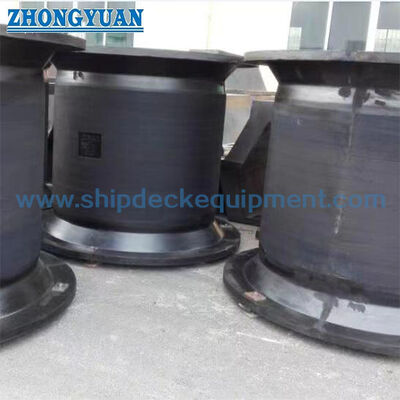
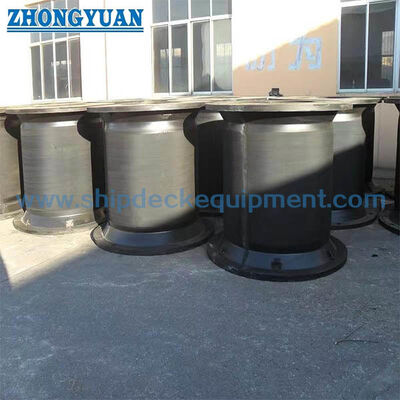
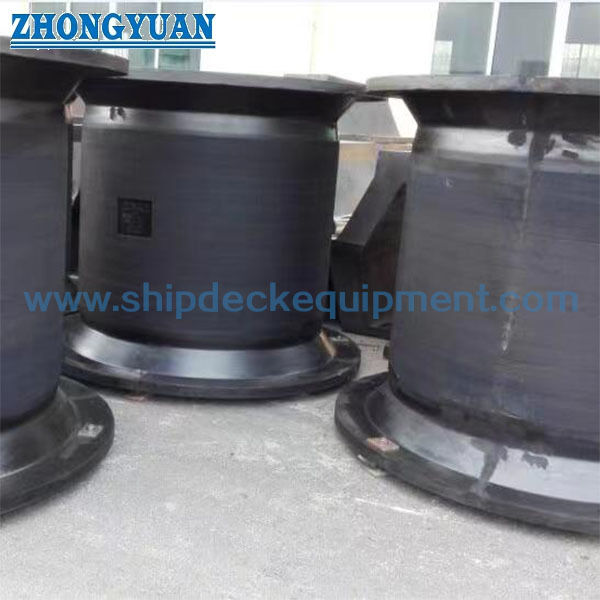
Super Cell Rubber Fender for Ports and Marine Terminals is a fixed axial-compression fender with a hollow cylindrical rubber body and integral mounting flanges. The supplied series covers nominal heights from 400 to 3,000 mm, with catalogue-rated performance at 52.5% axial deflection. The geometry provides a broad mounting footprint for load transfer into the berth structure and is well suited to systems using a steel frontal panel.
A complete cell fender system can combine one or more rubber units with a fabricated closed-box steel front panel, bolted UHMW-PE facing pads, anchors and hot-dip galvanized support/restraint chains. Final fender grade, panel area and chain arrangement are selected from berthing energy, allowable reaction force, vessel hull-pressure limits, installation clearance and project-specific operating conditions.
Quick Specifications
- Product type: Fixed cell-type marine rubber fender
- Supplied nominal height range: 400–3,000 mm
- Catalogue-rated axial deflection: 52.5%
- Performance-curve reference compression: up to 55%
- Published performance groups: Upper-High | High | Standard | Low
- Typical system arrangement: Rubber unit | closed-box steel front panel | UHMW-PE facing pads | anchors | hot-dip galvanized chains
- Typical applications: Container, bulk, oil & gas, general cargo, ferry/RoRo and cruise terminals
- Rubber material control: tensile strength ≥16 MPa, elongation at break ≥400%, hardness ≤78 Shore A and compression set ≤30%, with additional rubber-property testing selected to suit the project specification.
Structure & Fender System Configuration
Cell rubber element | fabricated closed-box steel front panel | mechanically bolted UHMW-PE facing pads | anchor/embedded parts | weight, tension and/or shear chains as required by the system design.
The front panel is specified in Q355B steel to GB/T 1591-2018 or an approved equivalent unless a different project steel grade is required. The closed-box construction is subject to a tightness/leakage check to reduce the risk of water ingress. External steel surfaces are prepared to Sa 2½ and protected by a project-defined marine coating system aligned with ISO 12944; hot-dip galvanizing is used for chain assemblies where specified. Facing pads are virgin black UV-stabilized UHMW-PE, typically 50–80 mm thick, with final thickness determined by contact pressure, wear allowance and service conditions.
Main Technical Specifications: Feature
| Type | H | h | D1 | D2 | n-Φd | MD | h1 | L | Weight(kg) |
| SC-H400 | 400 | 25 | 550 | 650 | 4-Φ30 | 22 | 10 | 270 | 76 |
| SC-H500 | 500 | 25 | 550 | 650 | 4-Φ32 | 24 | 12 | 300 | 110 |
| SC-H630 | 630 | 30 | 700 | 840 | 4-Φ39 | 30 | 14 | 330 | 230 |
| SC-H800 | 800 | 30 | 900 | 1050 | 6-Φ40 | 32 | 14 | 360 | 410 |
| SC-H1000 | 1000 | 35 | 1100 | 1300 | 6-Φ47 | 39 | 18 | 430 | 790 |
| SC-H1150 | 1150 | 40 | 1300 | 1500 | 6-Φ50 | 42 | 22 | 500 | 1200 |
| SC-H1450 | 1450 | 47 | 1650 | 1850 | 6-Φ61 | 52 | 26 | 570 | 2300 |
| SC-H1600 | 1600 | 50 | 1800 | 2000 | 8-Φ61 | 52 | 28 | 570 | 3000 |
| SC-H1700 | 1700 | 55 | 1900 | 2100 | 8-Φ66 | 56 | 30 | 620 | 3600 |
| SC-H2000 | 2000 | 55 | 2000 | 2200 | 8-Φ74 | 64 | 32 | 700 | 5200 |
| SC-H2250 | 2250 | 60 | 2300 | 2550 | 10-Φ74 | 64 | 36 | 700 | 7400 |
| SC-H2500 | 2500 | 70 | 2700 | 2950 | 10-Φ74 | 64 | 38 | 700 | 10500 |
| SC-H3000 | 3000 | 75 | 3150 | 3350 | 12-Φ90 | 76 | 40 | 800 | 18500 |
Selection & Inquiry Guide
Step 1 – Define the berthing requirement: Provide vessel type and size range, berth arrangement, design berthing energy, allowable fender reaction and hull-pressure limit.
Step 2 – Select height and performance group: Match the required energy/reaction envelope at the specified operating condition; do not select by nominal fender height alone.
Step 3 – Define the frontal system: Confirm panel dimensions, UHMW-PE facing area/thickness, available installation clearance, anchor interface and required weight/tension/shear chains.
Step 4 – Confirm project conditions and verification: State temperature range, berthing angle/velocity assumptions, applicable design/test basis, documentation requirements and any third-party witnessing.
Key Engineering Advantages
- The 52.5% catalogue-rated axial compression provides a practical energy/reaction selection range for fixed berth fender systems.
- The circular mounting footprint distributes fender loads over a broad support area and integrates efficiently with large frontal panels.
- The cell geometry is stable under normal shear components; system chains can be added where panel weight, tensile load or shear restraint requires them.
- The H400–H3000 dimensional series supports a wide range of berth layouts without creating separate thin pages for individual sizes.
Installation & System Interface
The rubber cell is installed between the berth structure and the frontal panel. Sufficient radial and edge clearance must be provided for the rubber body to expand and deflect without interference. For multiple-unit arrangements, spacing must also prevent adjacent fenders or the panel structure from interfering throughout the compression cycle.
For new reinforced-concrete berths, cast-in anchors can be installed using a setting template. For existing structures, suitable post-installed anchors may be used only after structural verification. Final embedment, reinforcement, edge distances, panel geometry, chain brackets and chain lengths are established by the approved project GA and anchor layout.
Inspection & Documentation
Baseline quality verification includes visual and dimensional inspection, rubber physical-property tests, and full-scale compression verification of reaction force and energy absorption at the agreed test condition. Where the steel frontal panel is supplied, fabrication records can include weld inspection/NDT as specified, closed-box tightness or air-leakage testing, coating inspection and dry-film-thickness records. Galvanized chain assemblies and UHMW-PE facing materials are verified against the project specification.
PIANC Fender Guidelines 2024 (MarCom WG211) are the current international guidance for fender-system design, manufacturing and testing. Any statement of project compliance, type approval, product certification or witnessed testing must be tied to the actual contractual scope and supporting records.
Applications
Container & bulk terminals | oil & gas terminals | general cargo berths | ferry & RoRo terminals | cruise terminals | naval and multi-user berth projects where a fixed cell-type fender system is appropriate.
Drawing & Photos

FAQ
Q1:How is the correct Super Cell Rubber Fender selected?
A1:Select from required berthing energy and allowable reaction, then check hull pressure, height, panel size, clearance and project test conditions.
Q2:Can the cell fender be supplied with a front panel and UHMW-PE facing?
A2: Yes. It can be integrated with a closed-box steel panel, bolted UHMW-PE facing, anchors and project-designed chains.
Q3:What is verified before supply?
A3:The agreed ITP can cover dimensions, rubber properties, reaction/energy performance, panel fabrication/tightness, protection systems and material/document records.